
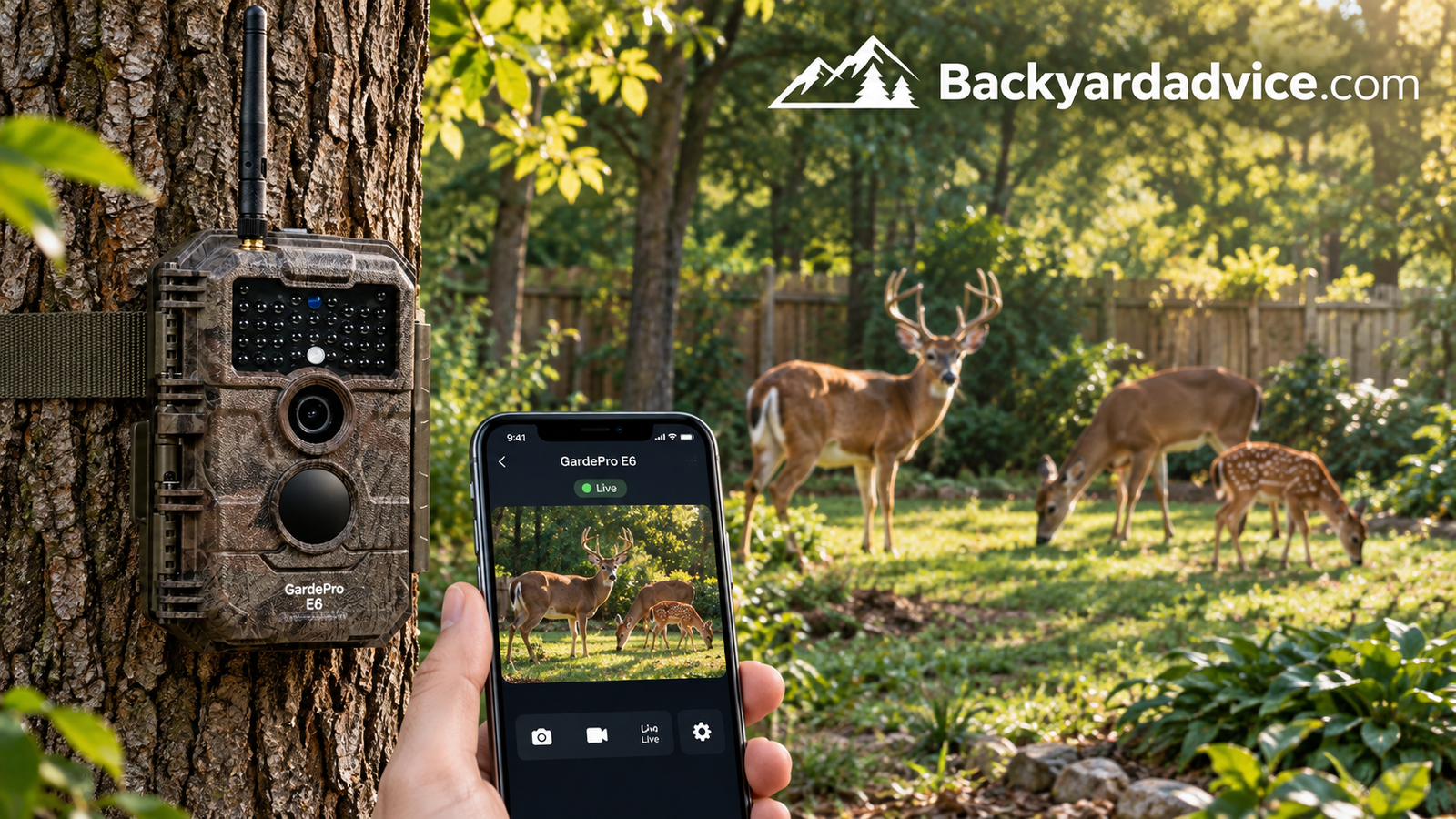
Best Backyard Wildlife Cameras: 10 Trail Cams for Watching What Visits After Dark
Solar-powered, WiFi, dual-lens, and cellular trail cameras compared — so you can finally see the foxes, birds, raccoons, and other visitors that treat your yard as their own.
The Secret Life of Your Backyard
Almost every backyard has a night shift. The birds you feed at breakfast are only the daytime cast; after the lights go off, an entirely different set of visitors arrives — and most homeowners never see a single one of them.
That is precisely what makes a backyard wildlife camera so addictive. Mount one near a feeder, a garden path, or the base of a tree, and within days you discover that your quiet suburban lawn is a well-used corridor. Foxes trot along the fence line. Raccoons work the compost. Rabbits graze at dawn. A possum waddles past the shed with the confidence of a creature who knows the schedule better than you do. If you have ever found mysterious tracks in soft soil or noticed the bird feeder emptied overnight, a trail camera turns speculation into footage.
The good news for backyard naturalists is that camera technology has moved firmly in their favor. The same trail cameras designed for hunters and researchers now shoot sharp stills and video, see clearly in total darkness using infrared flash, run for months on batteries or a solar panel, and send images straight to a phone over WiFi or a cellular connection. You no longer need to hike out to a remote site and swap memory cards to find out what happened — the backyard version of this hobby is remarkably low-effort.
This guide covers ten cameras that suit backyard use particularly well, from budget starters you can set up in ten minutes to solar-powered and cellular models that effectively run themselves. Along the way, we will cover the features that genuinely matter for backyard wildlife watching (and several that do not), where to aim a camera for the best results, and how to do all of it without disturbing the very animals you are trying to observe.
What this guide covers
- A master comparison table with every camera, its best use case, and a direct link.
- Detailed review blocks covering detection, night vision, power, connectivity, and who each model suits.
- A practical buying guide separating real-world essentials from marketing noise.
- Placement tips, privacy considerations, and a maintenance routine that keeps footage flowing.
One framing note before we begin: wildlife cameras reward patience and placement far more than they reward spending. A well-positioned mid-range camera will outperform a premium unit pointed at an empty stretch of lawn every time. So read the placement section carefully — it is where the real magic happens.
And if your backyard wildlife interest runs toward feathered visitors specifically, our guides to the best bird feeders for backyards and how to attract birds to your backyard pair beautifully with a trail camera. Set up the feeder, aim the camera at it, and you get a front-row seat to who is actually eating the seed.
Browse current wildlife and trail camera listings to compare detection features, power options, and connectivity.
Quick Comparison: Our Top Picks
Every camera in this guide appears below. Specs are described the way a backyard user actually experiences them — how it is powered, how footage reaches you, how it performs at night, and what kind of setup it wants — rather than in numbers that rarely translate to real use.
| # | Product | Best For | Key Specs | Verdict | Where to Buy |
|---|---|---|---|---|---|
| 1 | 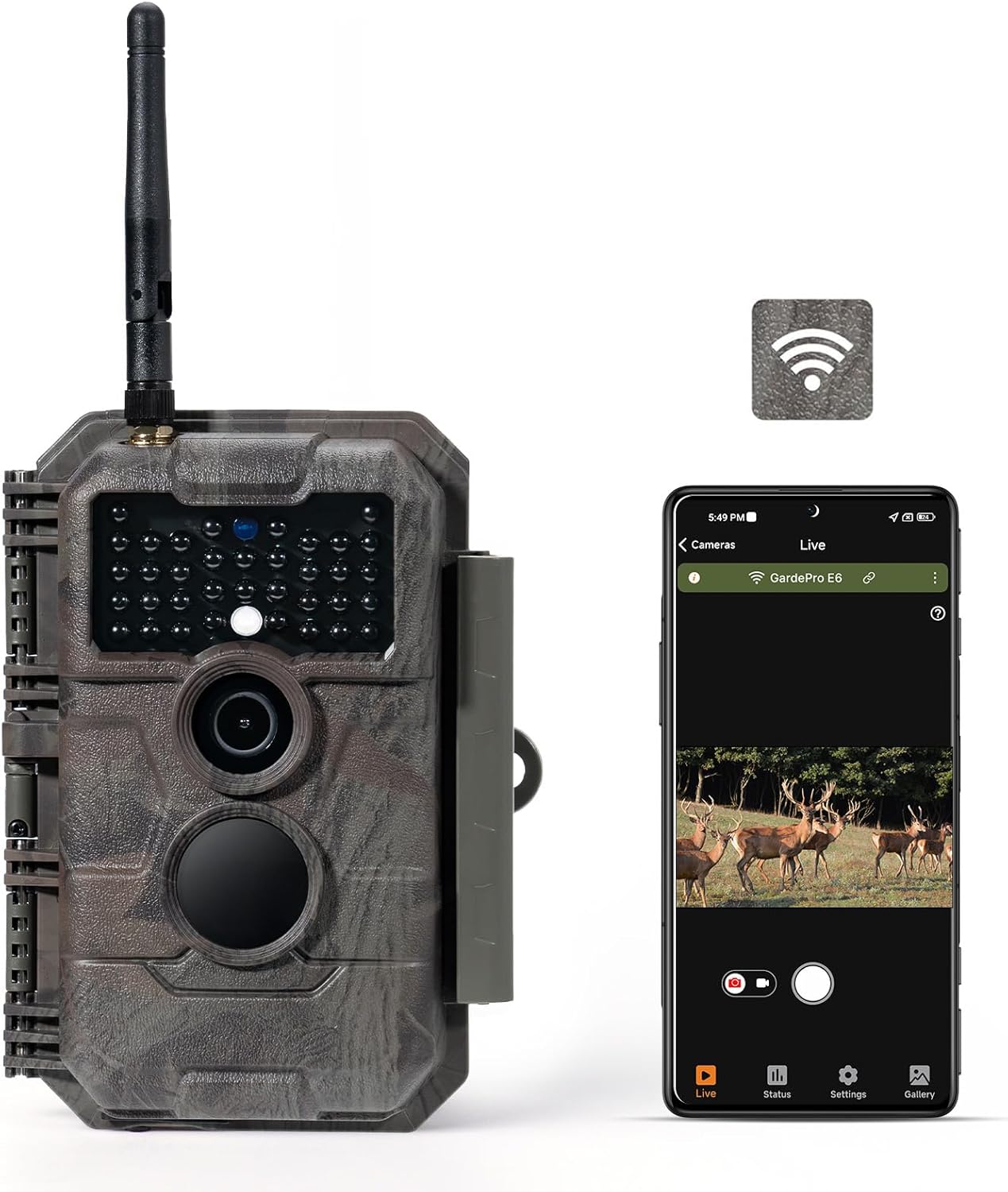 |
Top Pick GardePro E6 WiFi Trail Camera Best Overall |
|
The easiest camera to actually live with — grab footage from your phone without touching the unit. | Check Price on Amazon |
| 2 |  |
WOSPORTS G600-4K Trail Camera Best 4K Value |
|
Sharp daytime detail at a price that makes buying two cameras realistic. | Check Price on Amazon |
| 3 |  |
MAXDONE PH970S Solar Trail Camera Best Solar Wireless |
|
Mount it once and forget the battery routine entirely. | Check Price on Amazon |
| 4 |  |
TACTACAM Reveal X 3.0 (Cellular) Best Cellular |
|
Footage arrives on your phone from anywhere — the definition of set and forget. | Check Price on Amazon |
| 5 |  |
Moultrie Edge 2 Pro (Cellular) Best Cellular Runner-Up |
|
A polished ecosystem for people who want footage without the fieldwork. | Check Price on Amazon |
| 6 |  |
VOOPEAK Dual Lens Solar Trail Camera Best Dual-Lens Detail |
|
Separate optics for day and night means cleaner footage around the clock. | Check Price on Amazon |
| 7 |  |
Meidase P70 Trail Camera Best for Night Watching |
|
A no-drama workhorse that delivers usable night footage consistently. | Check Price on Amazon |
| 8 |  |
XTU Solar Trail Camera (WiFi) Best Value Solar |
|
The affordable way into solar-powered, phone-friendly monitoring. | Check Price on Amazon |
| 9 |  |
CEYOMUR CY40 Trail Camera Best Budget Starter |
|
A gentle introduction to the hobby without a serious commitment. | Check Price on Amazon |
| 10 |  |
SEHMUA Trail Camera Best Discreet Starter |
|
Small, quiet, and unobtrusive — ideal for close-in garden spots. | Check Price on Amazon |
Keep scrolling for full review blocks, including who each camera suits and what to know before you buy.
Start with the top pick, then compare it against the solar or cellular option that fits your setup.
How We Chose These Backyard Wildlife Cameras
Trail cameras are marketed to hunters, which means the spec sheets are full of numbers that matter enormously in a forest three miles from a road and matter very little at the bottom of your garden. We filtered for the things that actually decide whether a camera works for backyard wildlife watching.
Detection quality comes first. A wildlife camera lives or dies on its ability to notice a small animal moving quickly through the frame and capture it before it is gone. Fast trigger response, a sensible detection zone, and the ability to see creatures at close range all matter more than headline resolution. A raccoon that triggers the camera after it has already left the frame produces nothing but disappointment.
Night performance is the second pillar. Most backyard mammals are nocturnal or crepuscular, which means the majority of the footage you care about will be shot in darkness. We looked for cameras whose infrared illumination gives usable, identifiable footage without washing out close subjects — and, importantly, without startling the animals. Invisible or low-glow infrared keeps night behavior natural, which is exactly what you want to observe.
Power and retrieval determine whether you keep using it. This is where backyard users differ most from other trail camera buyers. If getting footage means climbing to a camera on a tree and hauling the card inside, you will do it for three weeks and then not again. Cameras with WiFi, Bluetooth, solar charging, or cellular delivery remove that friction, and that convenience is worth more to a hobbyist than an extra increment of image quality.
Weather resistance and build came next. Backyard cameras face sprinklers, direct sun, frost, curious children, and the occasional curious dog. Housing quality, sealing, and mounting hardware all tell you whether a camera will still be functioning at the end of the season.
Finally, we weighed setup simplicity and value. A camera that is easy to mount, easy to configure, and easy to understand gets used. A camera with a menu system like an aircraft cockpit gets returned.
Our selection criteria at a glance
- Detection: trigger speed, detection zone, and close-range performance.
- Night vision: clarity in darkness, infrared type, and impact on animal behavior.
- Connectivity: WiFi, Bluetooth, or cellular delivery of footage to your phone.
- Power: battery life, solar options, and how often you will be changing cells.
- Durability & usability: weather sealing, mounting, menus, and overall value.
Not every camera wins on every criterion, which is why this guide is organized by use case. A household that wants occasional snapshots of the garden has very different needs from one monitoring a chicken coop across the yard.
Open a few listings side by side and check detection features, power source, and connectivity against the criteria above.
GardePro E6 WiFi Trail Camera — Best Overall
If you want the camera that gets used the most after the first month, buy the GardePro E6. It is not the flashiest option here and it is not the cheapest — but it is the one that removes the biggest barrier between you and your footage: the walk to the tree.
With WiFi connectivity, the E6 lets you review what it has captured from your phone while standing on the patio with a coffee. That sounds like a small convenience until you have experienced the alternative — unscrewing a camera, bringing the card inside, copying files, and returning the camera to its spot, only to discover it was aimed slightly too high the entire time. Wireless retrieval collapses that whole routine into a few taps, and it means you check the camera constantly instead of occasionally.
The rest of the package backs that up. Night vision performance is handled well, giving usable identification of nocturnal visitors rather than the white blur that plagues lesser cameras. Motion detection is tuned for exactly the kind of subject backyard users care about — small to medium animals moving through a defined zone — and the housing is built for permanent outdoor installation.
Key features
- WiFi connectivity — review captured footage from your phone without removing the camera.
- Reliable night vision — infrared capture that identifies animals rather than just detecting shapes.
- Responsive motion detection — triggers quickly enough to catch animals in frame.
- Weather-ready housing — designed to stay mounted outdoors through the season.
- Straightforward operation — sensible controls that do not require a manual marathon.
What it is like to live with
The E6 rewards the setup most backyard users already have in mind: mount it low, point it at a path or feeding station, and let it run. Because you can check results from your phone, you refine placement fast — nudging the angle after the first day of footage rather than after a month of blanks.
That feedback loop is the hidden feature. Wildlife photography improves dramatically when you can iterate quickly, and the E6’s wireless retrieval turns placement from guesswork into a conversation with the camera. Owners who use it for garden bird activity, night visitors, or simply keeping an eye on what wanders through the yard tend to report the same thing: they had no idea how much was happening out there.
What we like
- Phone-based retrieval makes daily checking effortless.
- Night footage is genuinely usable and identifiable.
- Detection works well for small backyard wildlife.
- Set-and-forget outdoor durability.
Keep in mind
- WiFi retrieval has a limited range by design — you need to be nearby.
- Not solar-powered, so battery checks are still part of the routine.
See current availability and what is included in the package.
WOSPORTS G600-4K Trail Camera — Best 4K Value
There is a specific pleasure in seeing a visitor clearly enough to identify it — not “something small and fast” but the actual animal, with markings visible and eyes catching the infrared. The WOSPORTS G600-4K exists to deliver that pleasure at a price that does not require justifying the hobby to anyone.
The 4K designation in the name tells you where this camera puts its emphasis: capture detail. In practice, that shows up in daytime footage where you can genuinely study what you are looking at — feather patterns on a bird, the gait of a fox, the way a squirrel naviges a fence. For anyone building a personal archive of backyard visitors, that resolution pays off every time you review the card.
It is also a very sensible camera for covering more than one spot. Because the price sits comfortably below premium territory, buying two and monitoring the feeder and the back fence simultaneously becomes realistic. Wildlife observation improves enormously with two angles — you start to understand patterns rather than isolated incidents.
Key features
- 4K capture — high-resolution detail straight from the product name.
- Infrared night vision — continues recording after dark without visible flash.
- Fast motion trigger — catches animals as they enter the frame.
- Compact camouflage body — blends into garden and woodland settings.
- Multi-camera friendly — affordable enough to cover two locations.
What it is like to live with
The G600-4K follows the classic trail camera routine: mount, aim, and check the card periodically. That is more hands-on than WiFi or cellular models, but it suits people who enjoy the ritual of discovery — the walk to the tree, the card swap, the first look at what the night produced.
Pair it with a well-chosen subject and it shines. Aim it at a bird feeder and you get extraordinary detail of visitors throughout the day; our guide to identifying birds in your backyard becomes far more useful when you can freeze a frame and study the markings at leisure.
What we like
- Excellent detail for the money, especially in daylight.
- Compact, camouflaged body that disappears against bark and foliage.
- Realistic price for a two-camera backyard setup.
- Night vision keeps the observation running around the clock.
Keep in mind
- Card retrieval is manual — no wireless transfer.
- Best results come from thoughtful placement and regular card swaps.
Check the current listing and package contents.
MAXDONE PH970S Solar Trail Camera (WiFi/Bluetooth) — Best Solar Wireless Pick
Two chores kill the wildlife camera hobby: changing batteries and hauling memory cards. The MAXDONE PH970S eliminates both. Solar charging handles the power question, and WiFi plus Bluetooth handle retrieval — so the camera sits on the tree, does its job, and feeds you footage without asking anything in return.
That combination changes the character of the experience. Instead of a project that requires maintenance, you get a passive window onto the garden that simply keeps producing. Solar-assisted power means the camera is drawing from sunlight during the day, which dramatically reduces the battery anxiety that comes with leaving a camera in place for months.
The dual wireless approach is well judged. Bluetooth handles quick, close-range interactions — configuration, checks, and fast retrieval when you are standing next to the camera — while WiFi covers more comfortable footage review from a short distance. Between the two, you rarely need to touch the device at all.
Key features
- Solar charging — keeps the camera powered without a constant battery routine.
- WiFi and Bluetooth — two convenient ways to retrieve and manage footage.
- Cable-free installation — no wiring to run and no outlet to find.
- App-based retrieval — check results from your phone rather than the tree.
- Low-touch ownership — designed to be mounted once and left alone.
What it is like to live with
This is the camera you install and then genuinely forget about — in the best way. Solar charging rewards good placement: a spot with reliable daylight on the panel keeps the system topped up, which means the camera stays online through the weeks when you are busy and not thinking about it.
It pairs naturally with a feeding station or a garden feature that draws regular visitors. If you are setting up a bird feeding area as described in our guide to attracting birds to your backyard, a solar wireless camera nearby captures the daily activity without any ongoing effort from you.
What we like
- Solar power removes the biggest ongoing chore.
- WiFi plus Bluetooth covers every retrieval scenario.
- Truly cable-free, mount-anywhere installation.
- Perfect for permanent, long-term placement.
Keep in mind
- Solar performance depends on a reasonably sunny mounting spot.
- Wireless retrieval still requires being within range of the camera.
See current availability and what comes in the box.
TACTACAM Reveal X 3.0 (Cellular) — Best Cellular Wildlife Camera
Cellular trail cameras change the relationship between you and the subject entirely. Rather than collecting footage, you receive it — images and clips arrive on your phone from wherever the camera happens to be standing. The TACTACAM Reveal X 3.0 is the strongest expression of that idea for backyard use.
Why does that matter in a yard you walk past every day? Because the best wildlife moments do not happen on your schedule. The fox at two in the morning, the hawk that lands for ninety seconds at midday, the deer that passes through once a week — cellular delivery means you know about these events as they happen rather than discovering them days later, by which time the interesting behavior has long since passed.
It also enables genuinely hands-off monitoring. Place the camera, confirm it is reporting, and then let it work. For anyone with a large property, a garden feature some distance from the house, or a chicken coop that deserves security monitoring, that remote awareness is transformative.
Key features
- Cellular image delivery — footage comes to your phone wherever you are.
- Remote, low-touch operation — no card swaps and no walks to the tree.
- Strong night performance — handles the hours when most visitors arrive.
- App-managed footage — review, organize, and save sightings from your phone.
- Set-and-forget reliability — built for long-term, unattended deployment.
What it is like to live with
Ownership of a cellular camera is quieter than any other type. The camera works, the phone buzzes, and you get a small window into a moment you would otherwise have missed. Over weeks, that produces something no other approach matches: a continuous record of how your backyard actually behaves.
Do note that cellular cameras work within a connected ecosystem — the camera delivers footage over a mobile network, and that service is typically managed through the accompanying app. Check the current listing for the specifics of how connectivity and any ongoing service work before you buy, so there are no surprises.
What we like
- Footage arrives automatically — the ultimate in convenience.
- Remote awareness for larger properties and outlying features.
- Excellent for security-adjacent uses like monitoring coops.
- Genuinely unattended operation over long periods.
Keep in mind
- Requires mobile coverage at the mounting location.
- Cellular delivery typically involves a service or plan through the app.
Review current connectivity options and package details.
Moultrie Edge 2 Pro (Cellular) — Best Cellular Runner-Up
Moultrie has been in the trail camera business long enough to know that hardware is only half of the experience. The Edge 2 Pro reflects that thinking: the camera is capable, but what really distinguishes it is the ecosystem around it — the app, the remote management, and the sense that the whole system was designed by people who actually use these things.
For backyard wildlife watching, that polish matters more than raw specifications. You are going to interact with this camera’s app far more often than you interact with the camera itself. A clean interface that makes it obvious what happened last night, and easy to save the good clips, turns a technical device into a pleasant daily habit.
As a cellular unit, it delivers the same fundamental benefit as the Reveal: footage arrives without you going to fetch it. Combined with robust outdoor construction and remote manageability, that makes the Edge 2 Pro a strong choice for permanent installation in a spot you do not want to revisit often.
Key features
- Cellular connectivity — images delivered remotely to your device.
- Refined app experience — a polished way to review and manage footage.
- Remote management — adjust and monitor without approaching the camera.
- All-weather housing — built for permanent outdoor placement.
- Established trail camera heritage — design informed by long field experience.
What it is like to live with
The Edge 2 Pro suits households that want a monitoring system rather than a gadget. Once it is in place and connected, the camera becomes infrastructure — like the lights or the sprinkler — quietly doing its job while the interesting parts arrive in your pocket.
It is also a natural fit for properties where wildlife and livestock interact. If you keep chickens and want to understand what approaches the coop overnight, our guide to keeping chickens in your backyard is worth reading alongside a cellular camera setup. Knowing who visits is the first step in keeping your flock secure.
What we like
- Excellent app and remote management experience.
- Cellular delivery removes all retrieval work.
- Solid, permanent-installation build quality.
- Strong choice for security-adjacent monitoring.
Keep in mind
- Cellular systems depend on network coverage and a service relationship.
- Priced above non-cellular alternatives, as expected.
Check the current listing for connectivity and service details.
Meidase P70 Trail Camera — Best for Night Wildlife Watching
Most backyard wildlife cameras are bought for daytime curiosity and used almost entirely at night. That is when the mammals come out, when the garden belongs to its other residents, and when the footage gets genuinely interesting. The Meidase P70 is built with that reality in mind.
Night performance is where trail cameras separate into two groups: those that merely detect that something passed through, and those that produce footage you can actually learn from. The P70 falls firmly in the second camp, with an infrared system designed to give identifiable results in darkness without startling the subject into bolt-mode. For observing natural behavior — feeding, patrolling, foraging — that non-intrusive quality is essential.
It also keeps things simple. There is no complex connectivity to configure and no app ecosystem to learn. You set it up, it detects motion, it captures, and you review the results. For a lot of people, that simplicity is a feature rather than a limitation.
Key features
- Night vision focus — designed to deliver usable footage in full darkness.
- Reliable motion detection — consistent triggering for small, fast-moving animals.
- Straightforward operation — simple setup and no learning curve.
- Durable outdoor build — handles weather and permanent mounting.
- Behaviour-friendly infrared — observes without disrupting natural activity.
What it is like to live with
The P70 is the workhorse of the lineup. Point it at a garden path, a compost area, or the gap under a fence, and it quietly accumulates evidence of a nocturnal world most homeowners never witness. Within a week, you will know the regular visitors and roughly when they arrive.
That knowledge is surprisingly useful. Understanding what uses your garden at night informs everything from how you secure bins to how you protect plants — and it makes the whole space feel more alive. If a pond is part of the picture, our guide to building a pond in your backyard covers a feature that reliably draws nocturnal visitors into view.
What we like
- Night footage that is genuinely informative.
- Consistent detection of small backyard species.
- Simple enough for anyone to set up and use.
- Durable, permanent-installation build.
Keep in mind
- No wireless retrieval — footage is collected from the card.
- Less convenient for remote or hard-to-reach placements.
See the current listing and package contents.
VOOPEAK Dual Lens Solar Trail Camera (4K, WiFi/Bluetooth) — Best Dual-Lens Detail
Every trail camera faces the same optical compromise: daytime and nighttime conditions want different things from a lens. Cameras with a single optical path have to split the difference. Dual-lens designs like the VOOPEAK take the smarter route — separate optics dedicated to each job — and the result is cleaner footage in both directions.
Combine that with 4K capture from the product name, solar charging, and WiFi/Bluetooth connectivity, and the VOOPEAK becomes a genuinely modern package: high-detail capture, no battery routine, and phone-based retrieval. It is the camera for people who want everything at once and are prepared to have it.
For backyard use, the dual-lens approach is particularly valuable because the lighting conditions vary so wildly. Bright afternoon sun on a bird feeder and total darkness under the hedge at midnight are, optically speaking, different worlds — and this camera is equipped for both.
Key features
- Dual lens system — dedicated optics for daytime and nighttime capture.
- 4K detail — high-resolution capture straight from the product name.
- Solar charging — continuous power without battery swaps.
- WiFi and Bluetooth — wireless footage retrieval and easy configuration.
- Full-featured package — detail, power, and convenience in one unit.
What it is like to live with
This is the camera that produces the footage you will actually show people. Between the dual-lens clarity and the high resolution, clips tend to look less like surveillance footage and more like actual wildlife observation — which is exactly the point for anyone documenting the birds and animals in their garden.
With solar power and wireless retrieval, the daily burden is close to zero. Mount it where the panel gets light, confirm the connection, and let it accumulate the season.
What we like
- Dual lenses mean strong performance day and night.
- High-detail capture that rewards close study.
- Solar power plus wireless retrieval = almost no chores.
- One of the most complete feature sets available.
Keep in mind
- Feature-rich designs come at a higher price than basic models.
- Solar placement still needs a reasonably bright spot.
Check current availability and package details.
XTU Solar Trail Camera (WiFi) — Best Value Solar Pick
Solar power and wireless retrieval used to be premium features. The XTU brings both into reach at a value-oriented price, which makes it the sensible way to find out whether a solar, phone-friendly setup suits your garden before investing in a top-tier unit.
The formula here is simple and effective: solar charging reduces maintenance, WiFi removes the card-swapping routine, and the camera handles the core jobs of detection and night capture without fuss. Nothing about it is complicated, and nothing requires a manual to understand.
That makes it an excellent choice for a second location too. Many backyard setups end up with a main camera aimed at the busiest spot and a secondary one covering a gate, a shed corner, or a compost area. A value solar model fills that second role perfectly.
Key features
- Solar charging — fewer battery worries than conventional models.
- WiFi connectivity — retrieve footage without removing the camera.
- Cable-free setup — mount it anywhere with a bit of daylight.
- Value-focused package — the solar and wireless experience at a lower cost.
- Beginner friendly — simple to install, simple to run.
What it is like to live with
The XTU does the quiet work of making wildlife watching sustainable. Because both of the main chores are reduced, it is the kind of camera that is still running in month four — which, in this hobby, is the single biggest predictor of whether you get great footage.
Mount it with the panel toward daylight, aim it at a spot animals already use, and you have a self-sustaining observation post. For households that keep bird feeders, that combination is hard to beat: the feeder draws the visitors, and the camera records them while you are indoors.
What we like
- Solar power and WiFi at a value price.
- Extremely easy to install and operate.
- Great second-camera option for wider coverage.
- Low maintenance keeps the hobby going long-term.
Keep in mind
- Value positioning means fewer refinements than premium models.
- WiFi retrieval requires being within range of the camera.
See the current listing and what is included.
Best Budget Starter Cameras: CEYOMUR CY40 & SEHMUA
Not everyone wants to commit to the full wildlife camera experience on day one, and that is completely reasonable. Maybe you are curious rather than certain. Maybe it is a gift for a young nature enthusiast. Maybe you just want to know what knocked over the plant pots. For all of those situations, a capable entry-level camera is exactly the right purchase — and the two below are the best of them.
| # | Product | Best For | Key Specs | Verdict | Where to Buy |
|---|---|---|---|---|---|
| 1 | |
Top Pick CEYOMUR CY40 Trail Camera Best Budget Starter |
|
The gentlest introduction to wildlife watching — no fuss, no learning curve. | Check Price on Amazon |
| 2 | |
SEHMUA Trail Camera Best Discreet Option |
|
Compact and unobtrusive — disappears into close-in garden spots. | Check Price on Amazon |
| 3 | |
XTU Solar Trail Camera (WiFi) Best Step Up |
|
For when the starter camera has proved the hobby is worth keeping. | Check Price on Amazon |
CEYOMUR CY40 Trail Camera — Best Budget Starter
The CY40 is designed around a simple idea: the first wildlife camera should be easy. Easy to mount, easy to configure, easy to understand when you review what it captured. It handles motion-triggered stills and video and includes night vision, which covers the essentials of backyard wildlife watching completely.
That accessibility makes it a genuinely good gift, particularly for younger nature enthusiasts who want to see what visits the garden. There is no intimidating menu system and no ecosystem to join — just a camera that works.
- Simple, beginner-friendly setup — ready to mount and run in minutes.
- Motion-triggered capture — records activity as it happens.
- Night vision capability — keeps watching after dark.
- Approachable controls — no manual marathon required.
- Low-commitment price — an easy way to try the hobby.
What we like
- Genuinely easy for absolute beginners.
- Covers all the essentials of backyard monitoring.
- Excellent as a gift or a first experiment.
Keep in mind
- No wireless retrieval — footage comes from the card.
- Basic compared with solar or cellular models.
Check the current listing and package contents.
SEHMUA Trail Camera — Best Discreet Option
Wildlife is easily spooked, and some backyard spots call for a camera that simply does not draw attention. The SEHMUA is the compact, low-profile option of the group — a camera that mounts unobtrusively and goes about its business without announcing itself.
That discreetness matters at close range. Cameras mounted near feeders, garden beds, or patio edges are close to the animals they observe, and a large, obvious unit can change the behaviour you are trying to record. A smaller body with weather-resistant construction handles those placements gracefully.
- Low-profile design — unobtrusive in close-in garden locations.
- Motion detection — triggers on activity in its zone.
- Night vision capability — extends observation into the dark hours.
- Weather-resistant build — suitable for permanent outdoor mounting.
- Compact form — easy to mount in tight or sheltered spots.
What we like
- Small and discreet enough for close-range placement.
- Weather-resistant for outdoor use.
- Straightforward to mount and operate.
Keep in mind
- Entry-level feature set compared with premium models.
- Manual footage retrieval from the card.
See the current listing and available packages.
Buying Guide: What Actually Matters in a Backyard Wildlife Camera
Trail camera specifications are written for a different customer than most backyard buyers. Understanding which numbers translate to real-world wildlife watching — and which are simply marketing — saves money and disappointment in roughly equal measure.
Resolution: helpful, but not the whole story
Higher resolution is genuinely useful when you want to identify a species from a still frame, and 4K-class capture from models like the WOSPORTS G600-4K and VOOPEAK delivers that beautifully. But resolution does not help at all if the camera misses the trigger moment or blows out the exposure in darkness. Think of resolution as the ceiling on quality, with detection and night performance setting the floor.
Detection: the spec that decides everything
Trigger speed, detection range, and the shape of the detection zone determine whether you get footage of an animal or an empty frame with a blurred tail at the edge. For backyard use, where subjects are small and often fast-moving, responsive detection matters enormously. Cameras tuned for larger subjects at distance sometimes miss the quick, close visitors that make garden monitoring so rewarding.
Night vision: infrared type matters to the animals
All serious trail cameras use infrared illumination, but they differ in how visible it is to wildlife. Low-glow or invisible infrared is preferable for observation, because a bright flash of visible light changes animal behavior and can discourage repeat visits. Since most of your footage will be nocturnal, this is a spec worth paying attention to — the Meidase P70’s night-focused design is a good example of prioritizing it.
Power: match it to how often you want to visit
Standard battery-powered cameras work perfectly well but require periodic cell changes. Solar models like the MAXDONE PH970S, XTU, and VOOPEAK largely eliminate that routine, which is a genuine quality-of-life upgrade for permanent placements. If the camera is going somewhere awkward to reach, solar is not a luxury — it is the difference between a camera that runs and one that quietly dies in September.
Connectivity: WiFi, Bluetooth, or cellular
WiFi and Bluetooth models let you retrieve footage without removing the camera, which is ideal for cameras you can walk to. Cellular cameras like the TACTACAM Reveal X 3.0 and Moultrie Edge 2 Pro deliver footage over mobile networks — the right choice for distant placements, large properties, or anyone who wants alerts as events happen. Both approaches work well; the question is simply how far away the camera will be.
The five-minute buying checklist
- Where will it go? Close and reachable = WiFi/Bluetooth. Far or awkward = cellular or solar.
- What do you want to know? Species ID favors resolution; behavior favors good night vision.
- How often will you visit? Rarely = solar power and wireless retrieval.
- How many spots? Coverage beats quality when monitoring several areas.
- What will you do with footage? Casual viewing needs less than building a season-long archive.
One last consideration: think about the whole backyard ecosystem, not just the camera. The most productive wildlife camera setups are aimed at places animals already visit — feeders, water sources, sheltered paths, and garden features. A camera pointed at an empty lawn produces nothing regardless of how good it is.
Once you know your placement and connectivity needs, compare models directly and pick the right fit.
Camera Placement, Privacy & Maintenance: Getting the Most From Your Setup
You can buy the best wildlife camera in the world and still get nothing if it is aimed at the wrong place. Placement is where backyard wildlife watching succeeds or fails, and the good news is that a few simple principles cover almost every situation.
Aim where animals already are
Wildlife is habitual. Animals use the same routes, the same gaps under fences, the same sheltered edges of the garden, night after night. Look for the evidence before you mount anything: worn paths in grass, droppings, tracks in soft soil, nibbled plants, or the place where the hedge meets the lawn. Aim the camera along these natural corridors rather than across open ground.
Water and food are the strongest attractants in any garden. A camera pointed at a bird feeder, a shallow dish, or a pond edge will outperform one pointed anywhere else by a wide margin. Our guides to attracting birds to your backyard and choosing the best bird feeders cover how to concentrate activity in exactly one spot — which is precisely what a camera needs.
Height and angle
Mount cameras lower than most people expect. For small garden wildlife, knee height or lower captures far more useful footage than a camera at eye level, where animals pass beneath the detection zone. Angle slightly downward if the camera allows, and keep the trigger zone clear of moving branches and tall grass that cause false triggers and drain batteries.
Also consider distance to the subject. Cameras produce their best footage within their optimal range, and close subjects fill the frame with recognizable detail. In a backyard, that closeness is easy to achieve — use it.
Privacy and being a good neighbor
A wildlife camera is a camera. Position it so that it faces your garden rather than a neighbor’s property, a shared path, or a public space, and be thoughtful about where footage of people could be captured. In most places, simply being sensible about placement and honest with neighbors about what the camera is for resolves any concerns before they start. A camera aimed at a bird feeder rarely raises questions; one aimed over a fence always does.
Maintenance that keeps footage flowing
Wildlife cameras are low-maintenance, not maintenance-free. Wipe the lens and the infrared window regularly — a film of dust or pollen noticeably degrades night footage. Check the housing seal and mounting strap at the start of each season, clear vegetation that has grown into the detection zone, and manage power according to the camera’s design: fresh cells for battery models, clean panel surfaces for solar ones.
Finally, manage the environment around the camera. A comfortable, well-kept garden invites wildlife, and unwelcome pests drive it away. If biting insects are shortening your evening sessions outdoors, see our guide to getting rid of mosquitoes in your backyard; for garden pests that damage plants and attract the wrong attention, our roundup of backyard mosquito repellents is a practical starting point.
Three things to check before you leave a camera out
- Aim: the trigger zone covers where animals actually walk, not empty ground.
- Clearance: no moving branches or grass inside the detection area.
- Visibility: the camera faces your property and respects neighboring privacy.
Mounting straps, brackets, and power accessories make placement easier and keep the camera secure.
Frequently Asked Questions About Backyard Wildlife Cameras
The questions backyard naturalists ask most often before buying — and the ones that save the most time afterwards.
What is the difference between a trail camera and a wildlife camera?
In practice, very little. Trail cameras are the underlying technology — rugged, battery-powered cameras that trigger on motion and work in darkness — originally developed for hunting and field research. “Wildlife camera” describes the same hardware used for observation rather than hunting. Every camera in this guide works perfectly for backyard wildlife watching; the differences between models are about power, connectivity, and image quality, not about the category.
Where should I place a wildlife camera in my backyard?
Aim it where animals already go. Natural corridors like fence lines and hedge gaps, feeding stations, water sources, and sheltered garden edges all produce far more footage than open lawn. Mount the camera lower than feels natural — around knee height works well for small garden species — and angle it slightly downward. Clear moving vegetation from the detection zone to prevent false triggers.
Do wildlife cameras work at night?
Yes, and that is when most of the interesting footage is captured. Trail cameras use infrared illumination to see in total darkness, and quality varies significantly between models. Cameras with strong night performance — like the Meidase P70, or dual-lens designs like the VOOPEAK — produce footage you can actually identify animals in, rather than just detect that something passed through.
Will the camera disturb the animals?
Modern trail cameras are designed to be unobtrusive, and most wildlife quickly ignores them entirely. The main consideration is the infrared flash: low-glow or invisible infrared has minimal effect on behavior, while cameras with visible flash can startle animals and discourage repeat visits. For observation purposes, choose a camera with discreet night illumination, and place it where it does not block a route animals rely on.
Do I need a WiFi or cellular camera for my backyard?
It depends on how far the camera will be from where you sit. WiFi and Bluetooth cameras let you retrieve footage from your phone without touching the device, which is perfect for cameras within a short walk. Cellular cameras deliver footage over mobile networks and suit distant placements, large properties, or anyone who wants alerts as events happen. Both remove the memory-card routine; the question is simply distance and how much you want to know immediately.
How long do batteries last in a trail camera?
It varies widely with usage, temperature, and how many triggers the camera records each night. Cameras aimed at busy areas with frequent motion consume power faster than those monitoring quiet spots. Solar models like the MAXDONE PH970S or XTU largely remove the question by topping up from daylight. Whatever you choose, checking power during a regular outdoor routine makes battery life a non-issue.
Can I use a wildlife camera for security?
Many people do. Cellular models in particular are used to monitor driveways, outbuildings, chicken coops, and garden sheds, delivering alerts when something moves. That said, a wildlife camera is optimized for capturing animals, not faces or license plates — if security is your primary goal, look for cameras designed with that use in mind, and always be thoughtful about privacy and where the camera points.
How do I get better footage of birds during the day?
Concentrate the activity. Place a feeder or water source in a clear, open spot within the camera’s optimal range, and aim slightly downward so small birds fill more of the frame. Good daylight makes higher-resolution cameras like the WOSPORTS G600-4K really shine. Our guides to bird feeders and attracting birds cover how to build exactly the kind of hotspot that produces consistent, detailed footage.
What memory card do I need?
Most trail cameras use standard memory cards, and the manufacturer’s guidance for the specific model is the best source for compatibility and capacity. As a general principle, larger-capacity cards mean fewer trips to swap cards, and reliable, well-known card brands avoid the corruption issues that ruin a week of footage. If you are unsure, check the camera’s listing before ordering cards alongside it.
Do wildlife cameras record video or just photos?
Most modern trail cameras do both, and you can usually choose between them or use a combination. Video shows behavior — how an animal moves, feeds, and interacts — while stills are easier to review in volume and identify species from. Many backyard users settle on a mixed approach: stills for everyday monitoring and video when they are hoping to capture something specific.
How do I keep the camera from being stolen or knocked over?
Placement is the best defense. Cameras mounted high on a tree or tucked into foliage are far less conspicuous than those at eye level on a fence post, and a solid mounting strap keeps everything stable in wind. In gardens where other people have access, discreet positioning and a camera that blends into its surroundings — like the low-profile SEHMUA — make theft less likely.
What else can I do to encourage more wildlife into my garden?
Food, water, and shelter are the three pillars. Bird feeders and native plantings draw daytime visitors, a shallow water source or pond attracts a remarkable range of species, and hedges, log piles, and quiet corners provide shelter for mammals. Our guides to building a pond, attracting birds, and maintaining a wildlife-friendly garden cover the practical steps — and once the visitors arrive, the camera captures everything.
Browse current wildlife camera listings and compare power options, connectivity, and night vision side by side.
Final Verdict: Which Backyard Wildlife Camera Should You Buy?
For most people, the answer is the GardePro E6 WiFi. It hits the sweet spot that matters most in a backyard: capable detection and night vision, reliable outdoor build, and — crucially — phone-based retrieval that makes checking the camera a daily pleasure rather than a chore. It is the camera that keeps getting used, and a camera that keeps getting used is the one that produces the best footage.
If you want the lowest possible maintenance, go solar. The MAXDONE PH970S combines solar charging with WiFi and Bluetooth for genuinely hands-off operation, while the XTU brings the same solar-and-wireless formula to a value price point. For maximum detail in every frame, the WOSPORTS G600-4K and the dual-lens VOOPEAK Solar deliver the resolution that turns snapshots into study material.
For remote monitoring, cellular is unmatched. The TACTACAM Reveal X 3.0 and Moultrie Edge 2 Pro both deliver footage straight to your phone over mobile networks, and they are the right choice for large properties, distant placements, and anyone who wants to know the moment something happens.
Night-focused observers should look closely at the Meidase P70, while first-time buyers and gift-givers will find the CEYOMUR CY40 and the discreet SEHMUA to be friendly, capable entry points into a hobby that has a way of becoming a lifelong fascination.
Whichever camera you choose, remember where the real gains come from: aim it where animals already go, keep it powered and clean, and give the garden reasons to attract visitors in the first place. Do that, and you will be amazed at what has been happening in your backyard all along.
Check today’s price on our top pick and start capturing the wildlife you never knew you had.
You May Also Like
Best Fire Pit for Your Backyard
Warmth, atmosphere, and a natural gathering spot for cool evenings outdoors.
Buying GuideBest String Lights for Backyard
Weather-ready lighting that turns the garden into an evening destination.
How-ToHow to Build a Fire Pit in Your Backyard
A step-by-step build for a feature the whole household will use.
ExplainerCan I Have a Fire Pit in My Backyard?
What to check before lighting the first fire — rules, placement, and safety.
How-ToHow to String Lights Across a Backyard
Layout ideas and hanging methods for clean, safe overhead lighting.
ExplainerWhy Birds Leave Backyard Feeders
The common reasons your feeder goes quiet — and how to bring them back.
Buying GuideBest Backyard Playsets
Swings, slides, and climbing frames that turn a lawn into a playground.
Buying GuideBest Backyard Grill
Charcoal, gas, and everything-in-between picks for outdoor cooking.
Buying GuideBest Backyard Trampolines
Family trampolines, toddler models, and springless premium picks compared.
Buying GuideBest Backyard Pizza Oven
From casual weekend baking to serious high-heat outdoor pizza making.
Buying GuideBest Backyard Projector
Outdoor cinema setups for warm nights and family movie marathons.
ExplainerCan I Have Chickens in My Backyard?
Space needs, neighborhood rules, and what to know before adding a coop.
How-ToHow to Build a Pond in Your Backyard
Water features that attract wildlife and transform the feel of a garden.
How-ToHow to Get Rid of Mosquitoes in Your Backyard
Practical control strategies for reclaiming warm evenings outdoors.
ExplainerCan You Bury Your Dog in Your Backyard?
A gentle, practical look at the rules and considerations involved.