
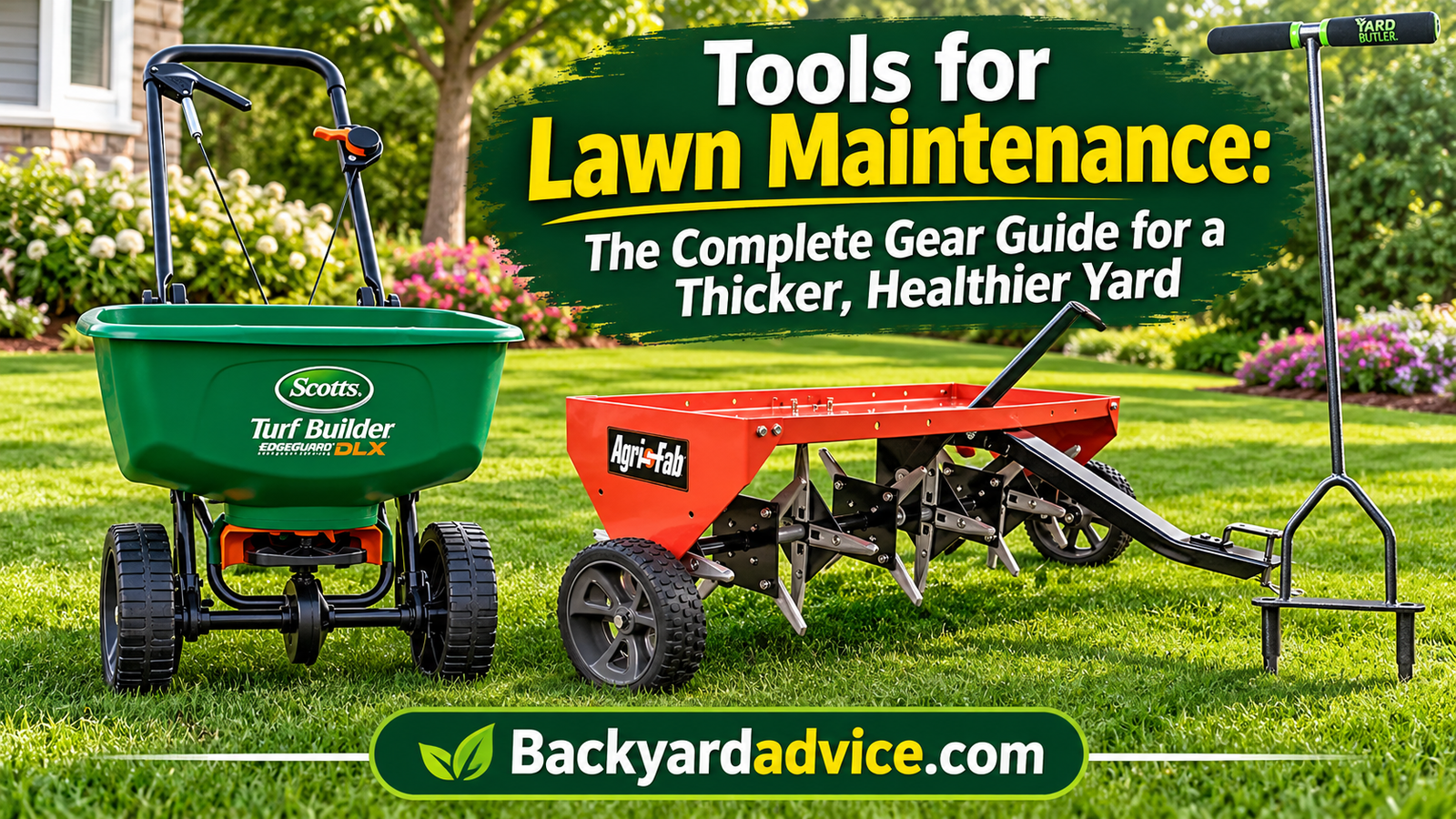
Tools for Lawn Maintenance: The Complete Gear Guide for a Thicker, Healthier Yard
Spreader, aerator, dethatcher, soil loosener — four jobs, ten tools, one calmer lawn. Here is what each one actually does, where it shines, and how to pick the right combination for the yard you have.

A Lawn Is a Living System — and It Needs Tools, Not Just Products
Most people treat lawn care as a shopping list: seed, fertilizer, weed control. But the grass itself is only half the picture. The other half is the soil beneath it — how compacted it is, how well water and air move through it, and how much dead material is stacked between the soil and the sunlight.
That is where tools for lawn maintenance earn their space in the shed. A spreader decides whether your feed lands evenly or scorches stripes across the yard. An aerator relieves the compaction that mowers, foot traffic, and clay soil create over time. A dethatcher lifts out the spongy layer of dead stems and roots that blocks new growth. A liquid soil loosener helps water travel down instead of running off the surface. Each of these is a job that no bottle or bag can do on its own.
The tricky part is that these tools look deceptively simple. A broadcast spreader is basically a hopper on wheels; a plug aerator is a tray of hollow tines you drag behind a tractor. Yet the difference between a tool that fits your yard and one that fights you for an entire Saturday is enormous. Tow-behind equipment that is perfect for a half-acre lawn becomes absurd on a small courtyard. A manual coring tool that is a joy on a tiny patch turns into a workout across a quarter acre. And wearable aerator spikes, which promise the easiest solution of all, work differently from a true core aerator in ways that matter.
In this guide, we walk through ten specific tools that cover the four core lawn maintenance jobs: feeding, aerating, dethatching, and soil conditioning. We explain what each tool is designed to do, where it performs well, where it has limits, and who should buy it. If you have been staring at a thinning lawn and wondering whether the problem is the seed, the weather, or something underneath, there is a good chance the answer is a tool you do not own yet.
- Feeding & spreading
- Core aeration
- Thatch removal
- Soil conditioning
- Storage & upkeep
Building Your First Lawn Tool Kit?
Start with the fundamentals and add specialty gear as your lawn asks for it.
Browse Lawn Care Tools on AmazonQuick Comparison: Our Top Picks
Ten tools, four jobs, one table. Skim this first if you already know what your lawn needs — then jump to the full review further down for the detail.
| # | Image | Product | Key Specs | Verdict | Check Price |
|---|---|---|---|---|---|
| 1 |  |
Top PickScotts Turf Builder EdgeGuard DLX Broadcast SpreaderBest Overall |
|
The everyday tool most lawns are missing first. | Check Price on Amazon |
| 2 | |
Agri-Fab 45-0299 48-Inch Tow Plug AeratorBest for Large Yards |
|
Big coverage with very little physical effort. | Check Price on Amazon |
| 3 |  |
Sun Joe AJ801E Electric Scarifier + Lawn DethatcherBest Two-in-One |
|
One machine covers both dethatching and scarifying. | Check Price on Amazon |
| 4 |  |
Greenworks 10 Amp 14″ Corded DethatcherBest Lightweight Dethatcher |
|
Easy to push, easy to store, easy to like. | Check Price on Amazon |
| 5 |  |
Brinly PA-40BH Tow-Behind Plug AeratorBest Durable Tow Aerator |
|
A rugged, no-nonsense compaction workhorse. | Check Price on Amazon |
| 6 |  |
Worx WG850 12-Amp Corded DethatcherBest for Steady Power |
|
Consistent power for thicker, tougher thatch. | Check Price on Amazon |
| 7 |  |
Yard Butler Manual Lawn Coring AeratorBest Manual for Small Lawns |
|
Precision aeration without any machine at all. | Check Price on Amazon |
| 8 |  |
Landzie Hollow Tine Manual Core AeratorBest Hollow-Tine Manual |
|
True core removal for spot work and beds. | Check Price on Amazon |
| 9 |  |
Ohuhu Lawn Aerator ShoesBest Wearable Option |
|
A hands-free way to tackle small trouble spots. | Check Price on Amazon |
| 10 |  |
Simple Lawn Solutions Liquid Soil LoosenerBest Liquid Companion |
|
Low-effort support for drainage and soil structure. | Check Price on Amazon |
Not Sure Where to Begin?
If your lawn is fed but still thin, aeration is usually the missing step.
See Lawn Aerators on AmazonWhy the Right Lawn Tool Matters More Than the Bag of Seed
When a lawn struggles, the instinct is to feed it more. Often the smarter move is to give it room to breathe.
Compaction: the problem you cannot see
Every step you take, every mower pass, every season of settling presses soil particles closer together. In heavy clay that happens faster; in sandy soil it happens more slowly, but it still happens. Compacted soil behaves like a pot with no drainage holes. Water sits on the surface and runs off toward the driveway, roots hit a hard layer and spread sideways instead of down, and fertilizer washes away before the grass can use it.
The visible symptoms are familiar: patches that brown out first in heat, areas where the mower leaves tracks, and spots that stay spongy after rain but crack in a dry spell. None of that gets fixed by adding more product. It gets fixed by removing small plugs of soil so air, water, and roots can travel again — which is precisely what the aerators in this guide are built to do.
Thatch: the layer that chokes new growth
Thatch is the tightly woven mat of living and dead stems, roots, and clippings that collects between the green blades and the soil surface. A thin layer is harmless and even protective. Once it thickens, it becomes a roof over the root zone. Water beads on top of it, disease spores thrive in it, and new seedlings never reach soil at all. A dethatcher — also called a scarifier when it cuts deeper — combs that layer out mechanically so the lawn can regenerate.
Feeding: why the spreader matters more than the bag
Uneven feeding produces the striped, patchwork look that makes a lawn look worse than an unfed one. Over-application burns grass; under-application wastes product. A quality broadcast spreader with a proper edge guard keeps material off sidewalks and garden beds while distributing it consistently across the open area. It is the least glamorous tool in the shed and arguably the one you will use most often.
Soil structure: the quiet multiplier
Beyond mechanical aeration, there are liquid soil conditioners designed to help water move through compacted layers and improve overall soil tilth. They are not a replacement for core aeration on badly compacted ground, but they are a low-effort companion treatment that supports everything else you do. Think of them as maintenance between the big jobs.
Start With the Soil
Everything else in lawn care works better once the ground can breathe.
Shop Lawn Soil ConditionersBroadcast Spreaders: Where Every Lawn Program Starts
Before you buy another bag of anything, ask how evenly the last one went down. The spreader decides the outcome of every application that follows.
A broadcast spreader throws granular material in a wide fan as you walk, which is dramatically faster and more consistent than shaking product by hand. The two things that separate a good spreader from a frustrating one are the flow control — how precisely you can dial the application rate — and the edge guard, which blocks the throw on one side so you do not fertilize the sidewalk, the mailbox, or the flower bed.
What to look for in a walk-behind spreader
- An adjustable flow gate that opens and closes smoothly so you can match the rate printed on the product bag.
- A working edge guard that you can engage without stopping, so edging a driveway becomes a normal part of the pass.
- Wheels that track true on turf without digging in, so your coverage pattern stays predictable.
- A hopper shape that empties cleanly rather than leaving product stranded in corners.
Scotts Turf Builder EdgeGuard DLX Broadcast Spreader
This is the spreader that solves the most common lawn complaint: uneven feeding. The EdgeGuard DLX is a walk-behind broadcast spreader designed around the idea that you should be able to walk the entire lawn in one continuous pass — including the borders — without switching tools or manually shielding the edges. That single design choice is what makes it the default recommendation for anyone who feeds a lawn several times a year.
Key Features
- Built-in edge guard: blocks the broadcast throw on one side so product stays on the lawn and off hard surfaces and beds.
- Broadcast spreading action: distributes granular material in a wide, even fan rather than dropping it in a narrow band.
- Adjustable application control: lets you match the spread rate to the product you are applying.
- Walk-behind format: comfortable for ordinary residential yards and easy to steer around obstacles.
- Everyday versatility: suited to feeding, overseeding support, and other granular lawn treatments.
What We Like
- Edge guard removes the most tedious part of spreading
- Simple, intuitive operation with no learning curve
- Handles the full range of granular lawn products
- Compact enough to store in a small shed or garage
What to Keep in Mind
- A walk-behind is slower than tow-behind gear on very large properties
- Hopper capacity is sized for residential use, not acreage
- Best results still depend on walking at a steady pace
Best for: Homeowners who feed their lawn regularly and want clean edges, even coverage, and a tool that is genuinely pleasant to use.
Getting the best from any spreader
Two habits make a bigger difference than any feature list. First, apply in two lighter passes at right angles to each other rather than one heavy pass — this is how professionals avoid stripes. Second, clean the hopper and the gate after every use. Granular products attract moisture, and a gate that is corroded or clogged will not close properly next season, which guarantees an over-application.
Ready to Feed Your Lawn Properly?
An even application is the cheapest upgrade your lawn will ever get.
Check Price on AmazonTow-Behind Plug Aerators: Heavy-Duty Compaction Relief
If your lawn is large enough that walking it with a hand tool sounds unreasonable, this is the category that makes aeration practical.
Tow-behind plug aerators are pulled behind a riding mower or lawn tractor. They use hollow tines that punch into the ground and lift out small cores of soil, leaving open holes that air and water can enter immediately. This is fundamentally different from a spike aerator, which pushes soil sideways and can actually increase compaction around the hole. On lawns with heavy traffic or clay soil, true plug removal is the standard.
Because the machine does the pushing, the limiting factors become working width, weight, and tine quality rather than your stamina. A wider unit covers more ground per pass; a weighted tray helps the tines bite into dry or hard-packed ground; and durable tines keep their edge season after season.
Two tow-behind options compared
| Image | Product | Type & Use | Verdict | Check Price |
|---|---|---|---|---|
|
Section PickAgri-Fab 45-0299 48-Inch Tow Plug AeratorBest for Large Yards |
|
Maximum coverage per pass for big lawns. | Check Price |
|
Brinly PA-40BH Tow-Behind Plug AeratorBest Durable Tow Aerator |
|
Straightforward, rugged, built to be used hard. | Check Price |
Agri-Fab 45-0299 48-Inch Tow Plug Aerator
On a large property, aeration is a logistics problem before it is a gardening problem. The Agri-Fab 45-0299 answers that with its generous 48-inch working width, which lets you cover serious ground in a fraction of the passes a narrower unit would need. Because it is towed rather than pushed, the work becomes an easy drive behind your mower rather than an afternoon of physical labor.
Key Features
- 48-inch working width: covers wide areas quickly and reduces the number of passes needed.
- Tow-behind operation: attaches to a riding mower or lawn tractor for effortless coverage.
- Plug-style coring: removes cores of soil to genuinely relieve compaction rather than just marking the surface.
- Weight-ready design: supports added weight for harder or drier ground conditions.
- Transport-friendly: lifts clear for moving across driveways and paved areas.
What We Like
- Wide path makes big-law aeration a short job
- Requires almost no physical effort from the operator
- True core removal rather than surface spiking
- Suits uneven and expansive terrain
What to Keep in Mind
- Requires a riding mower or tractor to operate
- Too large for small yards and tight gates
- Needs dry-enough ground for the tines to penetrate well
Best for: Anyone with a riding mower and a large lawn who wants aeration done in one easy session rather than an all-day project.
Agri-Fab 45-0299 Tow Plug Aerator
Wide coverage, minimal effort, real core removal.
Check Price on Amazon
Brinly PA-40BH Tow-Behind Plug Aerator
The Brinly PA-40BH takes a deliberately simple approach: a solid tow-behind frame, a tray you can load for extra downward force, and hollow tines that do the actual work. There is nothing flashy here, and that is the appeal. For homeowners who aerate once or twice a year and want a tool that will still be doing the same job many seasons from now, this kind of straightforward build is exactly right.
Key Features
- Tow-behind plug design: pulled behind a mower so the machine supplies the force.
- Weighted tray: allows added weight to help the tines penetrate firm, compacted ground.
- Hollow tine coring: extracts soil plugs to open channels for air, water, and roots.
- Durable construction: built around a frame meant for repeated seasonal use.
- Simple setup: few moving parts and a design that is easy to understand and maintain.
What We Like
- Weight tray helps in tough, dry, or clay-heavy soil
- Robust build quality inspires confidence
- Easy to maintain and store between seasons
- Great value for a genuine plug aerator
What to Keep in Mind
- Narrower coverage means more passes on very large lawns
- You supply the weight for the hardest conditions
- Needs a tow vehicle — not for push-mower households
Best for: Homeowners who want a durable, dependable tow-behind aerator and prefer solid mechanical simplicity over features.
Brinly PA-40BH Tow-Behind Plug Aerator
Rugged, simple, and built for years of seasonal work.
Check Price on AmazonWhen a tow-behind is the wrong choice
If your lawn is small, full of tight corners, or accessible only through a narrow gate, a tow-behind aerator will frustrate you. It needs turning room, a suitable tow vehicle, and enough open turf to justify the width. In those situations, a manual coring tool gives you far better control — and that is exactly where the next category shines.
Big Lawn, Bigger Job?
Tow-behind aeration turns a full day of work into a short drive.
Check Price on AmazonManual Core Aerators: Precision Work in Tight Spaces
Sometimes the job is not the whole lawn. It is the worn path to the shed, the play area, or the strip along the driveway.
Manual core aerators are long-handled tools with hollow tines that you drive into the ground with your body weight and a rocking motion, then pull out to release a plug of soil. They are slow by design, and that is their strength. You can place every hole exactly where you want it, work around sprinkler heads and edging, and treat the specific areas where compaction is worst without touching the rest of the yard.
The distinction that matters most in this category is hollow tine versus solid tine. Hollow tines actually remove a core of soil, which is what relieves compaction and lets the surrounding soil expand into the space. Solid tines simply displace soil downward and sideways. Both tools here are coring tools, which means they do the real job.
Two manual aerators compared
| Image | Product | Type & Use | Verdict | Check Price |
|---|---|---|---|---|
|
Section PickYard Butler Manual Lawn Coring AeratorBest Manual for Small Lawns |
|
Effort in, real aeration out — exactly where you want it. | Check Price |
|
Landzie Hollow Tine Manual Core AeratorBest Hollow-Tine Manual |
|
True core removal for precise, targeted work. | Check Price |
Yard Butler Manual Lawn Coring Aerator
The Yard Butler is the classic answer for anyone who wants genuine aeration without owning a machine. It is a hand coring tool: you step it into the turf, rock it to slice the core, and pull it free to leave an open channel behind. On a small lawn, a shaded side yard, or a set of compacted patches near a gate or driveway, this is arguably more effective than any powered alternative — because you can put the holes exactly where the problem is.
Key Features
- Manual coring action: removes actual plugs of soil to relieve compaction.
- Long handle: lets you work standing up with a natural step-and-rock motion.
- Targeted treatment: ideal for worn paths, play areas, pet zones, and shaded patches.
- Compact storage: takes up almost no space compared with powered equipment.
- No power source required: works anywhere, any time, with no cord or fuel.
What We Like
- Precise control over exactly where you aerate
- Removes real cores rather than just poking holes
- Zero maintenance and no running costs
- Perfect for small lawns and problem spots
What to Keep in Mind
- Physically demanding across a large area
- Cores can stick in dry, heavy clay — moisten first
- Not practical for a full-size lawn on its own
Best for: Small yards, targeted problem areas, and anyone who wants true core aeration without investing in powered equipment.
Yard Butler Manual Lawn Coring Aerator
Precise, portable aeration for the spots that need it most.
Check Price on Amazon
Landzie Hollow Tine Manual Core Aerator
The Landzie is built around a hollow tine design, which is the detail that separates a real coring tool from a simple soil punch. Because the tine is hollow, it extracts a plug instead of compressing the surrounding soil, leaving clean open channels that roots and water can use. It is a natural fit for gardeners who want to work along borders, in lawn strips, or in high-traffic areas with the same precision they would bring to planting.
Key Features
- Hollow tine coring: extracts soil cores to genuinely open up compacted ground.
- Long-handled reach: comfortable standing operation with good leverage.
- Targeted placement: ideal for borders, lawn strips, and small turf areas.
- Simple construction: easy to clean, sharpen around, and store flat.
- Season-friendly: ready to use whenever soil moisture conditions are right.
What We Like
- True hollow-tine core removal in a hand tool
- Excellent for detail work around beds and edges
- Lightweight and easy to handle
- No setup, no fuel, no cords
What to Keep in Mind
- Coverage speed depends entirely on you
- Best results require moist, workable soil
- Repeated stepping can be tiring over long sessions
Best for: Gardeners who want the accuracy of a hollow-tine corer for spot work, borders, and smaller turf areas.
Landzie Hollow Tine Manual Core Aerator
Clean core removal for precise, hands-on lawn work.
Check Price on AmazonMake manual aeration twice as effective
Moisture is everything with hand tools. Water the lawn a day ahead — damp enough that the tine slides in, not so wet that the ground turns to mud — and the difference in effort is remarkable. Work in a grid pattern with overlapping rows, and leave the extracted cores on the surface to break down naturally; they return soil and microorganisms to the lawn while they decompose.
Prefer Hands-On Precision?
A good manual corer is the most underrated tool in lawn care.
Check Price on AmazonAerator Shoes: What They Can and Cannot Do
Wearable aeration is a genuinely useful idea — as long as you understand which job it is actually suited to.
Aerator shoes strap onto your ordinary footwear and put a set of spikes beneath your feet, so every step you take in the yard also punches a small hole in the soil. The appeal is obvious: you aerate while you walk, water, spread, or play with the kids. No bending, no pushing, no setup.
What they do is spike the soil. What they do not do is remove a core. That distinction matters, because spiking displaces soil laterally, which can compact the walls of the hole, while coring removes material and leaves it open. So think of aerator shoes as a maintenance tool for lightly compacted areas and high-traffic routes — not as a substitute for a full core aeration on a struggling lawn.
Ohuhu Lawn Aerator Shoes
The Ohuhu aerator shoes take the lowest-effort approach in this entire guide. Strap them on over your shoes, walk the lawn, and every step drives spikes into the turf. They are not going to replace a plug aerator on a compacted clay lawn, but for light maintenance, small yards, and the traffic lanes that get walked every single day, they are an easy and inexpensive habit to keep.
Key Features
- Strap-on spike design: fits over regular shoes for hands-free aeration while you walk.
- Adjustable fastening: secures the plate to your footwear for a stable stride.
- Even spike pattern: distributes holes across each step for consistent coverage.
- Ultra-compact storage: takes up less room than a pair of garden gloves.
- Multitasking friendly: lets you aerate while watering, spreading, or doing other yard tasks.
What We Like
- Effortlessly simple — you aerate while walking
- Great for small yards and high-traffic lanes
- Minimal cost and no maintenance
- Useful as a regular maintenance habit
What to Keep in Mind
- Spikes compact hole walls — no core removal
- Not a replacement for real aeration on bad soil
- Takes practice to walk naturally at first
Best for: Small lawns, light compaction, and homeowners who want to add a little aeration to their normal walking routine.
The honest verdict on wearable aeration
Use aerator shoes the way a gardener uses a hand fork: constantly, lightly, and on the areas that get the most wear. Then schedule a proper core aeration — manual or tow-behind — once the lawn shows real signs of compaction. That combination covers both ends of the spectrum, and it is exactly how a professional would sequence the work.
Low-Effort Lawn Maintenance
Small tools used consistently beat big tools used never.
Check Price on AmazonElectric Dethatchers and Scarifiers: Clearing the Layer Above the Soil
If aeration is about what happens under the turf, dethatching is about what has piled up on top of it.
An electric dethatcher looks much like a push mower, but instead of blades it uses a rotating set of tines or flails that rake through the grass canopy and pull out the thatch layer. A scarifier goes a step further, cutting grooves into the soil surface to break up dense mats and create better seed-to-soil contact. Both are seasonal jobs, and both are dramatically easier with the right machine.
Electric units are the sweet spot for most residential lawns. They start instantly, run quietly, and need none of the seasonal maintenance that gas equipment demands. The main consideration is power delivery: a corded model gives you unlimited runtime but requires you to manage an extension cord, while the motor size determines how confidently the machine handles thick, established thatch.
Three electric options compared
| Image | Product | Type & Use | Verdict | Check Price |
|---|---|---|---|---|
|
Section PickSun Joe AJ801E Electric Scarifier + Lawn DethatcherBest Two-in-One |
|
The versatility pick — one tool, two seasonal jobs. | Check Price |
|
Greenworks 10 Amp 14″ Corded DethatcherBest Lightweight Dethatcher |
|
Light, nimble, and genuinely pleasant to push. | Check Price |
|
Worx WG850 12-Amp Corded DethatcherBest for Steady Power |
|
Extra motor muscle for denser, tougher thatch. | Check Price |
Greenworks 10 Amp 14″ Corded Dethatcher
The first thing you notice with this Greenworks dethatcher is how easy it is to move. Its 14-inch working path keeps it maneuverable around beds, trees, and curved lawn edges, while the 10 amp motor handles routine thatch removal without drama. For a typical suburban lawn that gets dethatched once a year, this balance of size and power is exactly right — big enough to be efficient, small enough to be enjoyable.
Key Features
- 10 amp motor: handles routine dethatching jobs on residential lawns.
- 14-inch working path: compact enough to maneuver around beds, trees, and borders.
- Corded electric power: instant starting with no fuel, charging, or engine upkeep.
- Push-mower handling: familiar controls and a natural walking pace.
- Seasonal simplicity: plug in, rake the lawn clear, and get to work.
What We Like
- Lightweight and very easy to steer
- No gas, no batteries, no engine maintenance
- Compact working width suits tight and curved lawns
- Straightforward to store in a small space
What to Keep in Mind
- Cord management takes a little planning on big yards
- Smaller path means more passes on open lawns
- Best suited to routine rather than extreme thatch
Best for: Homeowners with small to mid-sized lawns who want a light, easy-handling dethatcher they can use once a season without fuss.
Greenworks 10 Amp 14″ Dethatcher
Light handling, honest power, zero engine upkeep.
Check Price on Amazon
Worx WG850 12-Amp Corded Dethatcher
Some lawns fight back. Thick, springy turf with an established thatch layer will bog down an underpowered machine, and that is where the Worx WG850 earns its place. Its 12-amp motor delivers the kind of steady, confident power that keeps the tines spinning through dense material instead of stalling. It is a dedicated dethatcher, and it does that single job with real conviction.
Key Features
- 12-amp motor: confident power for thicker and more established thatch layers.
- Corded electric drive: consistent output with no runtime limits.
- Dedicated dethatching design: focused entirely on lifting thatch from the turf canopy.
- Push-style handling: familiar and comfortable for anyone who mows their own lawn.
- Seasonal reliability: plug-and-go operation without fuel storage or engine servicing.
What We Like
- Strong motor holds its pace in tough thatch
- Unlimited runtime while plugged in
- Simple, focused design with little to go wrong
- No seasonal engine maintenance
What to Keep in Mind
- Requires a suitable outdoor extension cord
- Dedicated dethatcher only — no scarifying mode
- Heavier feel than the most compact models
Best for: Lawns with dense or stubborn thatch where motor strength matters more than compact handling.
Sun Joe AJ801E Electric Scarifier + Lawn Dethatcher
The Sun Joe AJ801E is the most versatile machine in this lineup because it does two related jobs rather than one. In dethatcher mode it combs out the thatch layer the way a standard unit does; switch it to scarifier mode and it works deeper, cutting into the soil surface to break up dense mats and prepare a better seedbed. If you like owning fewer tools that each do more, this is the logical choice.
Key Features
- Two-in-one function: operates as both a scarifier and a lawn dethatcher.
- Electric powered: instant start with no fuel mixing, storage, or engine service.
- Deeper scarifying action: helps break up compacted surface layers and dense thatch.
- Seedbed preparation: creates better soil contact for overseeding work.
- Push-mower format: simple, familiar handling for homeowners.
What We Like
- Two seasonal jobs in one machine
- Scarifying adds real depth to the work
- Excellent pairing with overseeding plans
- Quiet and easy to maintain
What to Keep in Mind
- Mode changes add a small setup step
- Corded design needs planning on larger lawns
- Scarifying is aggressive — use it at the right time
Best for: Homeowners who want one machine to handle both routine dethatching and deeper scarifying work.
Sun Joe AJ801E Scarifier + Dethatcher
Two jobs, one machine, one storage slot.
Check Price on AmazonHow to get the most from a dethatching session
Mow the lawn a little shorter than usual before you start so the tines reach the thatch instead of just tangling with tall blades. Work in slow, overlapping passes, then rake up what the machine lifts — and there will be a lot of it. Finish with a light feeding and, if the season is right, an overseed. That sequence is what turns a dethatcher from a cleaning tool into a renovation tool.
Clear the Layer That Chokes Your Lawn
Dethatching is the single most satisfying lawn job of the year.
Check Price on AmazonLiquid Soil Looseners: The Low-Effort Companion Treatment
Not every soil improvement job needs a machine. Some just need water to go where it should.
Liquid soil conditioners are formulated to help water penetrate compacted layers, improve soil structure, and support the biological activity that keeps ground healthy over time. They are applied with a hose-end sprayer or watering can, which makes them the lowest-effort item in this entire guide. Their role is support rather than replacement: think of them as the treatment you apply between core aerations to keep progress moving.
Where they genuinely shine is on lawns where standing water, runoff, or persistent dry patches point to a soil structure problem. Regular applications can make a noticeable difference in how evenly moisture is distributed through the root zone, which in turn affects how well your fertilizer and seed perform.
Simple Lawn Solutions Liquid Soil Loosener
This is the tool for the lawn owner who wants to do something useful but has a limited amount of time and energy. The Simple Lawn Solutions liquid soil loosener is designed to be mixed, applied, and left to work — no equipment, no heavy lifting, and no learning curve. Used alongside proper aeration and a sensible watering routine, it is an easy way to keep improving the ground beneath the grass.
Key Features
- Liquid soil treatment: formulated to improve soil structure and water movement.
- Simple application: mixes with water and applies through a sprayer or watering can.
- Compaction support: complements mechanical aeration on hard, slow-draining ground.
- Watering synergy: helps moisture reach the root zone more evenly.
- Season-long use: suitable as an ongoing part of a lawn care routine.
What We Like
- Requires no equipment beyond a sprayer
- Pairs well with core aeration and dethatching
- Easy to add to an existing watering routine
- Good option where machines cannot reach
What to Keep in Mind
- Not a substitute for core aeration on badly compacted soil
- Results build gradually rather than instantly
- Best applied when soil moisture is already reasonable
Best for: Homeowners who want steady soil improvement with almost no physical work, especially alongside aeration and overseeding.
Simple Lawn Solutions Liquid Soil Loosener
Low-effort soil improvement you can keep up all season.
Check Price on AmazonWhere liquid treatments fit in the bigger picture
The strongest results come from layering methods. Core aeration opens physical channels, a liquid loosener helps water use those channels, and a thin layer of topdressing or compost gradually rebuilds structure from above. None of those steps is dramatic on its own. Together, over a season or two, they produce the kind of deep-rooted, even-colored turf that looks effortless and is not.
Give Your Soil Some Help
A simple treatment that supports everything else on this list.
Check Price on AmazonMatching the Tool to Your Yard: A Practical Buying Guide
The best tool is not the most capable one. It is the one you will actually use on the lawn you actually have.
Buying lawn equipment is easy to overdo. It is tempting to buy the widest, most powerful, most complete version of everything — and then find that it does not fit through the side gate. Before you choose, look honestly at four things: the size of your lawn, the terrain and access, the soil type, and how much physical effort you are willing to spend.
Start with lawn size
| Lawn Size | Best Aerator Type | Best Dethatcher Approach | Spreader Style |
|---|---|---|---|
| Small yard or courtyard | Manual coring tool or aerator shoes for quick maintenance | Lightweight electric dethatcher with a compact path | Compact walk-behind broadcast spreader |
| Mid-size suburban lawn | Manual corer for spots plus shoes for regular upkeep | Electric dethatcher or two-in-one scarifier | Walk-behind broadcast spreader with edge guard |
| Large lawn or property | Tow-behind plug aerator behind a riding mower | Powered dethatcher with strong, steady motor output | Wide-coverage broadcast spreader |
| Heavy clay or compacted soil | Plug aerator with added weight, supported by liquid treatment | Scarifier mode to break the dense surface layer | Any even-coverage broadcast spreader |
Terrain matters more than you expect
A flat, open lawn is forgiving; a sloped, curved, obstacle-filled one is not. If your yard has hills, you already know how much difference the right equipment makes — the same thinking applies when you are choosing which mower handles the terrain, and our guide to the best lawn mowers for hills covers that in depth. Steep ground also changes aeration strategy: work across the slope rather than up and down it, and avoid tow-behind equipment on grades it was not designed for.
Soil type sets the schedule
Clay soils compact quickly and benefit from core aeration more often, usually once or twice a year in the growing season. Sandy soils drain well but can struggle with nutrient retention, which shifts the emphasis toward feeding and soil conditioning. Loam sits in the middle and forgives almost everything. If you are unsure which you have, dig a small hole after rain: clay holds together in a ribbon when squeezed, sand barely holds shape, and loam crumbles nicely.
Effort and storage are real constraints
Be honest about how much work you want to do. Manual tools are inexpensive, precise, and physically demanding. Tow-behind tools are effortless to use but demand storage space and a tow vehicle. Electric machines sit in the middle. And all of them need somewhere dry to live — a tool left outdoors in the off-season will cost you more in the long run than the one you paid extra for.
Find Your Match
Filter by yard size and soil type to narrow the field quickly.
Compare Lawn Tools on AmazonThe Seasonal Lawn Maintenance Calendar
Owning the tools is half the job. Using them in the right order is the other half.
Lawn care is rhythm work. Each task sets up the next one, and doing them out of order wastes product and time. What follows is a simple sequence that works across most climates, adjusted by your local growing season rather than a fixed calendar.
Early growing season: wake the lawn up
Begin with cleanup and a lower mow so the canopy is open. Then dethatch if the thatch layer is thick, because you want that cleared before feeding. Follow immediately with aeration on compacted areas and a light, even feed applied with a properly set spreader. This is also the moment to address bare spots while soil is warming and seed has time to establish. After a hard winter, it is worth getting the rest of the yard in order too — a well-kept lawn looks far better alongside a good backyard grill setup and tidy entertaining space.
Mid-season: maintain and protect
Mow high and often, water deeply rather than frequently, and keep feeding at a moderate, consistent rate. If the soil is slow to absorb water, add a liquid soil loosener to your watering routine. This is also when outdoor living reaches its peak, so if you are planning evening gatherings, a little planning goes a long way — see our guide to the best string lights for the backyard and our walkthrough on how to string lights across a backyard safely and neatly.
Late season: repair and prepare
This is the most underrated window of the year. Core aerate, overseed, and feed while soil is still warm but the worst heat has passed. Clear leaves before they mat down over the turf. And as the evenings draw in and you start using the yard for cool-weather gatherings, it is a good moment to think about warmth and safety — our guide to the best fire pits for your backyard, how to build a fire pit, and whether you can have a fire pit in your backyard covers that from every angle.
Dormant season: look after the equipment
Clean everything, drain and store anything with fluid, sharpen cutting edges, and put hand tools somewhere dry. A couple of hours in the off-season buys you years of service. Full details are in the next section.
Build a Season-Ready Tool Kit
One kit, one routine, and the lawn takes care of the rest.
Shop Lawn Care KitsTool Care, Storage, and Getting More Seasons Out of Your Gear
Lawn tools fail for boring reasons: moisture, residue, and neglect. All three are avoidable.
None of the tools in this guide are fragile. But they all involve metal, soil, moisture, and chemical products — a combination that quietly shortens lifespans when they are ignored. A little discipline after each use pays for itself many times over.
Clean before you store
- Spreaders: empty the hopper completely, open the gate, and brush out residual granules. Moisture turns leftover product into a hardened crust that prevents the gate from closing properly.
- Aerators: knock soil from the tines and rinse the frame. Dried clay is far harder to remove after a week than after an hour.
- Dethatchers: clear tine assemblies of wrapped grass and debris, and check for anything bent or loose.
- Manual tools: wipe blades, dry them, and add a light coat of oil to prevent rust.
Store dry and off the ground
Concrete floors sweat with temperature changes, so hanging tools on a wall rack or standing them on a shelf keeps metal away from persistent damp. Coil cords loosely rather than tightly wrapped, and keep everything away from direct contact with fertilizer products, which are corrosive to many metals over time.
Sharpen and inspect annually
Take one afternoon each off-season to inspect moving parts, tighten fasteners, check for cracked housings, and sharpen anything with a cutting edge. Dull tools force you to work harder and damage grass instead of helping it. If a component is worn, replace it rather than limping along — a well-maintained tool delivers noticeably better results than a neglected premium one.
Quick Care Checklist
- Empty and dry hoppers after every application
- Rinse tines and frames after soil contact
- Oil manual tool blades before winter storage
- Store off the ground in a dry, ventilated space
- Inspect fasteners and cables once a season
Protect Your Investment
Storage racks and tool care supplies cost less than replacing gear.
See Garden Tool StorageSafety, Comfort, and Ergonomics When Working on the Lawn
Most lawn injuries are small and preventable: strained backs, blistered hands, twisted ankles, and eyes irritated by dust.
Lawn maintenance is physically real work, and the difference between a pleasant afternoon and a sore week usually comes down to preparation. Footwear with real grip matters more than people expect, especially when pushing equipment on damp grass or working on a slope. Gloves protect against blisters, thorns, and product contact. Eye protection is worth wearing whenever you are spreading granular material or working with powered tines that can throw debris.
Set yourself up for comfort
- Warm up briefly. Two minutes of stretching prevents the awkward-strain injuries that come from cold muscles and sudden effort.
- Break jobs into blocks. Aerating and dethatching are repetitive; switch tasks every so often rather than grinding through.
- Use the right grip. Gloves with a good palm coating reduce hand fatigue dramatically during long sessions.
- Stay aware of cords and tines. With corded equipment, plan your route first and keep the cable on the unmowed side of the machine.
Comfort is also about the environment
Being outdoors in the yard is one of the great pleasures of having one, but biting insects can cut a session short. If mosquitoes are a problem where you live, our guides to the best backyard mosquito repellent and how to get rid of mosquitoes in the backyard cover practical, layered approaches that let you work and relax in peace.
Product handling basics
When applying granular or liquid lawn products, wear gloves, avoid windy days, follow the label exactly, and keep children and pets off treated areas for the stated interval. Store products in their original containers, sealed and out of reach. None of this is complicated, and all of it makes the work safer and more effective.
Work Safer, Work Longer
Good gloves and protective gear make every job more comfortable.
Shop Yard Work GlovesCommon Buying Mistakes — and How to Avoid Them
Most disappointment with lawn tools traces back to a handful of predictable, avoidable decisions.
Mistake 1: buying for the yard you wish you had
It is easy to convince yourself that a tow-behind aerator is worth it because one day you might move to a bigger property. In the meantime it sits unused in a shed you cannot fit it into. Buy for the lawn in front of you and upgrade when the lawn actually changes.
Mistake 2: assuming spikes equal coring
As covered earlier, spike tools displace soil while core tools remove it. If compaction is your real problem, a spike-only solution will leave you disappointed. Understand which mechanism you are buying before you buy it.
Mistake 3: ignoring storage requirements
Measure your storage space before you purchase. Tow-behind equipment needs width and clearance; electric machines need a dry corner and a safe place for the cord. A tool that cannot be stored properly will not last.
Mistake 4: skipping the spreader
Hand-application is the single most common cause of uneven lawns. If you are still broadcasting granular products by hand, a quality spreader is the highest-impact purchase on this entire list — and it pays for itself in product that lands where it should.
Mistake 5: treating tools as one-time purchases
Lawn care is a long game, and so is tool ownership. The lawn owner who gets the best results is usually not the one with the most equipment but the one who uses a small set consistently. A spreader, one aeration tool, and one dethatching solution, used on a real schedule, will outperform a garage full of gear that never leaves the wall.
And while you are thinking about the yard as a whole, it is worth remembering that a lawn is part of a larger outdoor space. A healthy, well-maintained lawn becomes the foundation for everything else you do outside — from birdwatching with the best bird feeders for your backyard to learning how to attract birds to your backyard.
Buy Once, Use Often
Choose the tools that fit your routine and keep them working.
Check Lawn Tool PricesFrequently Asked Questions About Lawn Maintenance Tools
Straight answers to the questions that come up most often when people start building a lawn tool kit.
What tools do I actually need for basic lawn maintenance?
For most residential lawns, the essentials are a broadcast spreader for even feeding, one aeration tool suited to your yard size, and a dethatcher or scarifier for removing thatch once a year. Everything else is support. Start with those three, use them consistently, and add items like liquid soil conditioners or aerator shoes only once you know your lawn’s specific needs.
How often should I aerate my lawn?
It depends on soil type and traffic. Lawns with heavy clay soil, lots of foot traffic, or visible compaction often benefit from aeration once or twice per growing season. Lighter soils with minimal wear may only need it every couple of years. The best signal is the lawn itself: water running off instead of soaking in, spongy turf, and thin patches are all good reasons to aerate.
What is the difference between a plug aerator and a spike aerator?
A plug aerator uses hollow tines that remove small cores of soil, leaving open channels for air, water, and roots. A spike aerator pushes solid tines into the ground, which displaces soil sideways and can actually increase compaction around each hole. For genuinely compacted ground, plug or core aeration is the more effective method, while spikes work fine for light surface maintenance.
Should I dethatch and aerate at the same time?
They are often done in the same session, but in a specific order: dethatch first to clear the layer above the soil, then aerate so the tines reach the ground rather than the thatch. Doing both while the lawn is actively growing and the soil is moist gives the fastest recovery. Follow with feeding or overseeding to take full advantage of the open ground.
Are aerator shoes as effective as a core aerator?
They do different jobs. Aerator shoes spike the soil as you walk, which is helpful for light, regular maintenance in high-traffic areas. A core aerator removes plugs of soil, which is what actually relieves compaction in a struggling lawn. Shoes are a great low-effort habit, but they are not a substitute for real core aeration when the soil is hard and compacted.
What should I look for in a fertilizer spreader?
Look for a smooth, adjustable flow control so you can match the application rate on the product label, and a working edge guard to keep material off paths and beds. Broadcast spreaders cover ground quickly and evenly, while drop spreaders offer more precise placement along borders. Even coverage matters far more than hopper size.
Do I need a tow-behind aerator or is a manual one enough?
It comes down to scale and access. Manual coring tools are excellent for small lawns, tight spaces, and precise spot treatment. Tow-behind plug aerators make sense when you have a riding mower, plenty of open turf, and a compaction problem that would take hours to address by hand. Many homeowners end up using both — one for the whole lawn, one for the trouble spots.
When is the best time of year to dethatch?
Dethatch when grass is actively growing and can recover quickly, which in most regions means the peak growing season for your grass type. Avoid dethatching during heat stress, drought, or dormancy, since the lawn cannot repair the damage. If you plan to overseed, dethatching immediately beforehand creates excellent seed-to-soil contact.
Can I use a liquid soil loosener instead of aerating?
They complement each other rather than replace each other. A liquid soil loosener improves water penetration and soil structure over time and is very low-effort to apply. Core aeration physically opens the soil immediately. On badly compacted ground, mechanical aeration gives you the breakthrough, and liquid treatments help maintain and extend those results between aeration sessions.
How do I keep my lawn tools in good condition?
Clean them after every use, especially anything that contacts soil or granular products. Empty and dry spreader hoppers, rinse tines and frames, oil manual tool blades, and store everything off the ground in a dry space. A short annual inspection for worn parts, loose fasteners, and dull edges will add years to the life of any lawn tool.
What should I look for in an electric dethatcher?
Motor strength, working path width, and how the power is delivered. A stronger motor handles thick, established thatch without stalling; a narrower path is easier to maneuver in tight or curved lawns. Corded electric models give unlimited runtime but require you to manage an extension cord, which is worth planning before you start the job.
Is corded electric equipment enough for a large yard?
It can be, but it requires planning. Corded machines run as long as you need, so runtime is never the issue — cable reach is. You will need a suitable outdoor-rated extension cord and a sensible route that keeps the cable clear of the working area. For very large properties, some owners prefer tow-behind or alternative power options for the biggest jobs.
Still Deciding?
Browse by category and compare the tools that fit your lawn.
Explore Lawn Maintenance ToolsThe Right Tools Make Lawn Care Feel Easy
A healthy lawn is not the result of one heroic weekend. It is the result of a handful of simple jobs, done at the right time, with tools that make those jobs easy enough that you actually do them.
If you take one thing from this guide, let it be this: start with the spreader. Even feeding is the foundation that everything else rests on, and the Scotts Turf Builder EdgeGuard DLX makes that job genuinely simple. From there, match your aeration tool to your lawn — a tow-behind plug aerator like the Agri-Fab 45-0299 for open acreage, a manual corer like the Yard Butler for smaller or tighter spaces, or the effortless middle ground of Ohuhu aerator shoes for regular light maintenance.
For thatch, an electric machine removes the layer that chokes new growth: the Greenworks for light handling, the Worx WG850 for tougher material, and the Sun Joe AJ801E when you want scarifying built in. And for ongoing soil improvement, the Simple Lawn Solutions liquid soil loosener adds value with almost no effort at all.
Buy for the yard you have. Store your tools properly. Use them on a rhythm rather than in a panic. Do those three things and the lawn will do most of the rest — and the time you save is the real reward, because it goes straight back into enjoying the yard instead of fighting it.
Ready to Upgrade Your Lawn Care Routine?
Start with one tool, use it well, and build from there.
Shop Lawn Care Tools on AmazonYou May Also Like
More guides to help you get the best out of your backyard.
How to Identify Birds in My Backyard
Simple cues for recognizing the regular visitors to your feeders and lawn.
Read guide → WildlifeWhy Birds Leave Backyard Feeders
The common reasons feeder traffic drops off — and what to change.
Read guide → Yard RulesCan You Bury Your Dog in Your Backyard?
What regulations and practical considerations you need to know first.
Read guide → FamilyBest Backyard Playsets
Play structures that suit different yard sizes, ages, and budgets.
Read guide → FamilyBest Backyard Trampolines
What to look for in safety, durability, and everyday usability.
Read guide → Outdoor CookingBest Backyard Pizza Oven
Turn your outdoor space into the neighborhood’s favorite kitchen.
Read guide → EntertainingBest Backyard Projector
Movie nights under the stars, with the features that actually matter.
Read guide → WildlifeBest Backyard Wildlife Camera
See who visits your yard when you are not watching.
Read guide → ProjectsHow to Build a Pond in Your Backyard
A step-by-step approach to planning, digging, and finishing a garden pond.
Read guide → Yard RulesCan I Have Chickens in My Backyard?
What to check before the coop goes up and the flock arrives.
Read guide →