
Backyard Golf Gear Guide
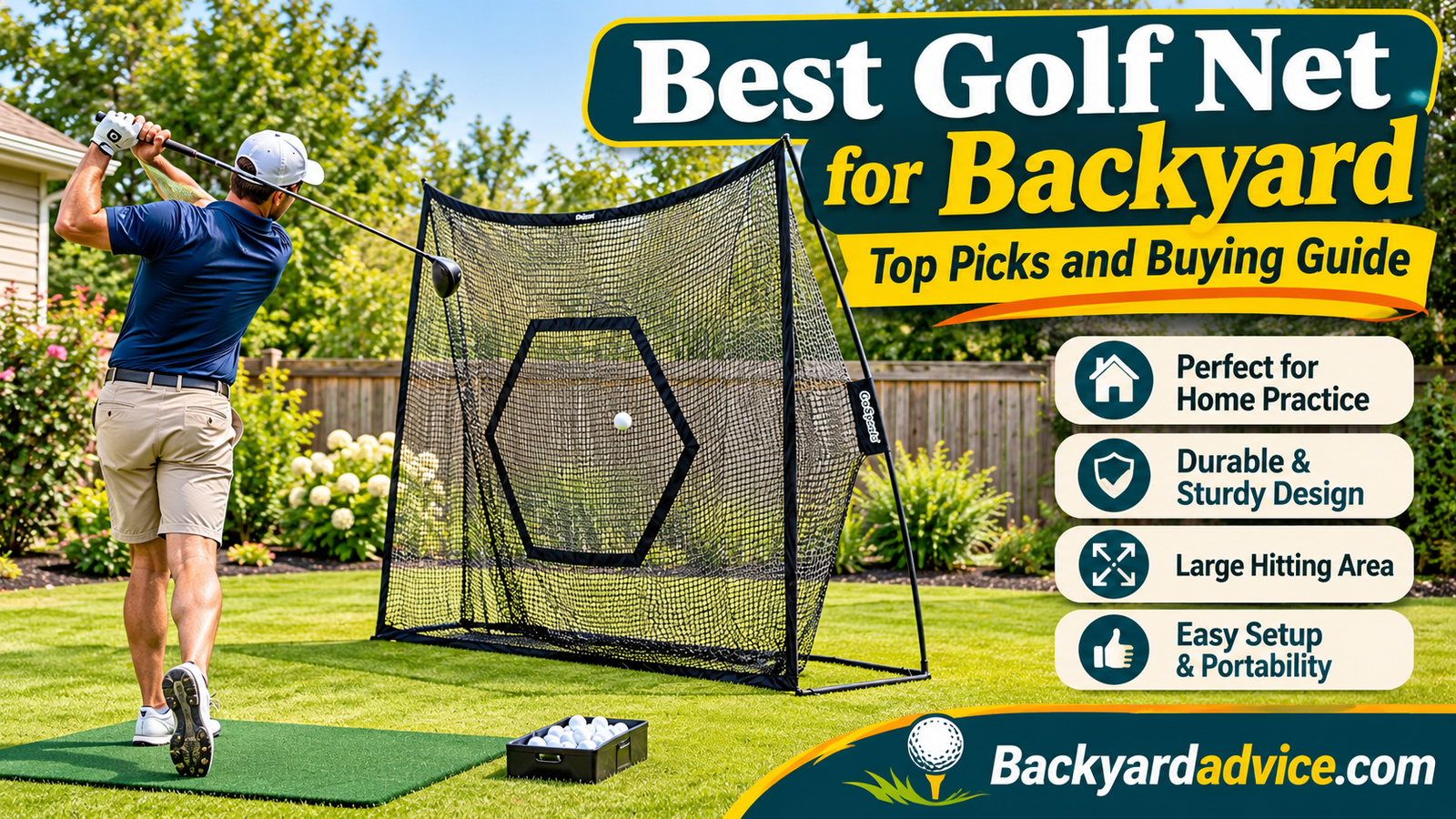
Best Golf Net for Backyard: Top Picks and Buying Guide
Fourteen nets tested by real-world criteria — hitting area, frame strength, ball control, and how much yard you actually need — so you can practice full swings and short game without leaving home.
A backyard golf net changes the shape of an ordinary evening. Instead of packing the bag, driving to the range, and paying for a bucket you’ll hit in fifteen minutes, you walk outside, take ten swings before dinner, and go back in. That repetition — small, frequent, low-effort — is what actually builds a swing. And it only happens when practice is easy to start.
That’s the real promise of a good backyard net: it removes friction. But not every net delivers it equally, and the differences show up fast once you start hitting balls at home. Some nets are large enough to catch a driver that drifts offline; others are built for chips and pitches and nothing more. Some frames survive years of wind and thousands of impacts; others wobble after a season. A few come with ball-return systems that quietly gather your shots so you’re not walking the lawn between every swing.
Four things decide whether a net will work for you. Size is the first: the hitting area has to match the shots you actually hit and the space you actually have. Build quality is the second — the frame, the connectors, and how the netting attaches all determine how long the thing lasts. Ball control matters more than most people expect: a net that drops balls at its base saves you time and keeps shots out of the neighbor’s yard. And available space is the constraint nobody can negotiate with, because a wide net in a narrow side yard simply won’t work.
This guide covers all of it. We start with fourteen top picks in a quick comparison table, then move through detailed reviews grouped by how the nets are actually used. After that, we walk through sizing, space planning, net types, extra features, setup, safety, care, practice habits, and the mistakes that leave people with a net they never use. By the end, you’ll know exactly what to buy and exactly where to put it.
Quick Comparison: Our Top Picks
Here’s the whole field at a glance. Every net in this guide appears in the table below with its standout strength, so you can shortlist in a minute and dig into the reviews that matter to you.
| # | Image | Product | Key Specs | Verdict | Check Price |
|---|---|---|---|---|---|
| 1 |  |
GoSports 10×7 ft Golf Practice Hitting NetBest OverallTop Pick |
|
The size-to-effort balance most backyards actually need. | Check Price on Amazon |
| 2 |  |
Spornia SPG-7 Golf Practice Net with Automatic Ball ReturnBest With Ball Return |
|
Fewer steps between swings means more swings per session. | Check Price on Amazon |
| 3 |  |
Amazon Basics Portable Golf Practice Hitting Net, 8 ft x 8 ftBest Budget Pick |
|
Straightforward netting that covers the basics well. | Check Price on Amazon |
| 4 |  |
The Net Return Pro Series V2 Multi-Sport Golf NetBest Multi-Sport Net |
|
One backyard target for golf, baseball, and more. | Check Price on Amazon |
| 5 |  |
Rukket Sports Haack Golf NetBest Rukket Option |
|
A big, forgiving surface for confident full swings. | Check Price on Amazon |
| 6 |  |
JEF World of Golf Collapsible Chipping NetBest Chipping Net |
|
Pops open in seconds for quick short-game reps. | Check Price on Amazon |
| 7 |  |
Gagalileo Golf Practice Net with Bullseye TargetBest Target Net |
|
A visible aiming point keeps practice purposeful. | Check Price on Amazon |
| 8 |  |
Hit Run Steal Heavy Duty Golf NetBest Heavy-Duty Pick |
|
For daily hitters who want the frame to keep up. | Check Price on Amazon |
| 9 |  |
Bearwill Golf NetBest Value Pick |
|
Solid everyday netting without overspending. | Check Price on Amazon |
| 10 |  |
PodiuMax Golf NetBest Portable Pick |
|
Moves between yard, garage, and driveway with ease. | Check Price on Amazon |
| 11 |  |
KOPUWS Golf NetBest Compact Pick |
|
Small-space friendly without feeling like a toy. | Check Price on Amazon |
| 12 |  |
KLAODOT Pauline CY Golf NetBest Easy-Setup Pick |
|
Goes up quickly when practice time is limited. | Check Price on Amazon |
| 13 |  |
Aoneky Golf Sports Practice Barrier NetBest Barrier Net |
|
Stops strays where space and neighbors are tight. | Check Price on Amazon |
| 14 |  |
Costway 3 in 1 Golf NetBest 3-in-1 Option |
|
One kit that covers more than one practice need. | Check Price on Amazon |
Looking for the Best All-Around Backyard Net?
Our top pick balances hitting area, stability, and easy setup.
Check Price on Amazon1. Best Full-Swing Golf Nets for the Backyard
Full-swing nets are the ones most people picture when they think about practicing at home: a large vertical hitting surface that catches drives, long irons, and everything in between. The design challenge is simple to describe and hard to execute — the net has to be tall and wide enough to absorb an offline shot, yet still fit in a real backyard and still be manageable for one person to move.
The six nets below are the strongest full-swing options in this guide. They differ in footprint, in how they handle the ball after impact, and in how much punishment the frame is built to take. Read them as a shortlist: pick the one whose trade-offs match your yard and your practice habits.
Top Pick
GoSports 10×7 ft Golf Practice Hitting Net
Best OverallIf you want one net recommendation and no second-guessing, this is the one we’d point most backyard golfers toward. The 10 x 7 ft hitting area is the sweet spot: generous enough to catch a driver that leaks right or left, but not so enormous that it swallows a modest lawn. It reads as a piece of equipment rather than a permanent structure, which matters when the yard doubles as a place to entertain.
Key Features
- 10 x 7 ft hitting area sized for full swings
- Foldable frame that packs down between sessions
- Netting built to absorb repeated high-speed impacts
- Backyard-friendly footprint for lawns and patios
Pros
- Wide hitting surface forgives miss-hits
- Sets up without permanent mounting
- Balances size with storage practicality
Cons
- Still demands real clearance behind the net
- Too large for very narrow side yards
Who it’s best for: Golfers who want a true full-swing net that fits a normal suburban backyard and can be set up and put away without a second pair of hands.
Spornia SPG-7 Golf Practice Net with Automatic Ball Return
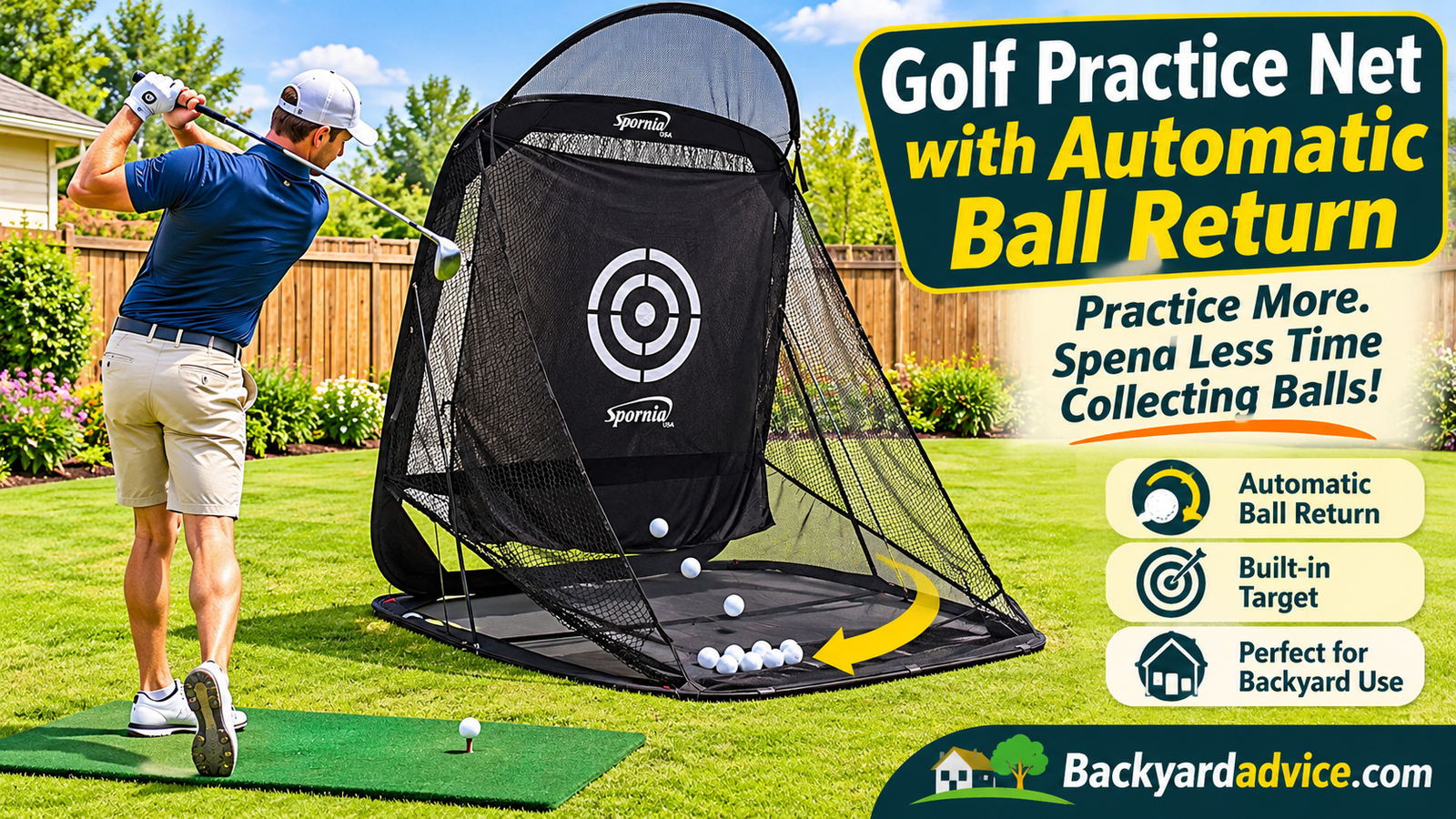
Best With Ball ReturnBall return is one of those features that sounds like a luxury until you’ve bent down to collect shots forty times in a session. The SPG-7 is built around that idea: hit, watch the ball settle, and have it come back to where you’re standing. The result is a rhythm that feels closer to a range bay than a backyard, and rhythm is what makes practice stick.
Key Features
- Automatic ball return that gathers shots after impact
- Compact footprint that suits smaller practice areas
- Target-style hitting face for aim and focus
- Design built for repeated, quick-fire sessions
Pros
- More swings per session, less ball chasing
- Friendly to tight spaces
- Encourages focused, target-driven practice
Cons
- Smaller surface than the biggest full-swing nets
- Return system needs correct setup to work cleanly
Who it’s best for: Anyone practicing frequently who values efficiency — fewer steps between shots means more swings in the same amount of time.
Amazon Basics Portable Golf Practice Hitting Net, 8 ft x 8 ft
Best Budget PickThere’s a version of golf practice that doesn’t need a target system, a ball return, or a frame engineered like scaffolding. It needs a net that stands up, catches balls, and doesn’t cost more than a couple of rounds of golf. That’s exactly the lane this net occupies, and the square 8 x 8 ft format gives it a taller catching area than its footprint suggests.
Key Features
- 8 x 8 ft hitting area with a tall catching surface
- Portable frame that stores between sessions
- Straightforward design with no extra moving parts
- Approachable option for first-time net buyers
Pros
- Tall catching area suits mid and short irons
- Simple to understand and maintain
- Good entry point before investing more
Cons
- Not as forgiving on wide misses as larger nets
- Fewer convenience features than premium options
Who it’s best for: New golfers, casual players, and anyone who wants a dependable net without paying for extras they may never use.
The Net Return Pro Series V2 Multi-Sport Golf Net
Best Multi-Sport NetA backyard net gets used by the whole household far more often than people plan for. This is the option that leans into that reality: a freestanding, ball-returning target that works for golf and for other backyard sports too. If you’ve got kids who throw, or you switch between disciplines seasonally, one versatile target beats three single-purpose ones cluttering the garage.
Key Features
- Multi-sport design suitable for golf and other ball sports
- Ball return that keeps practice moving
- Freestanding frame that can be repositioned
- Robust build intended for heavy, repeated use
Pros
- Serves more than one sport or skill
- Ball return speeds up every session
- Built to handle serious volume
Cons
- Bigger commitment in both cost and space
- Overkill if you only chip occasionally
Who it’s best for: Households where the backyard is a shared practice space for golf and other sports, and where one piece of gear has to earn its keep several ways.
Rukket Sports Haack Golf Net
Best Rukket OptionRukket has built its reputation on nets that feel substantial, and the Haack line is the clearest expression of that. The hitting face is large and visually bold, which does something subtle but important: it makes you swing freely. When the target looks forgiving, you stop steering the club and start training the motion — and that’s the whole point of backyard reps.
Key Features
- Large hitting face that catches wide dispersion
- Portable frame designed for setup and teardown
- Practice-target panel for aim and feedback
- Netting suited to full-swing impact speeds
Pros
- Confidence-inspiring surface for full swings
- Target panel adds purpose to each session
- Portable enough to relocate as needed
Cons
- Large footprint needs a real yard
- Bulkier to store than compact nets
Who it’s best for: Players who hit a lot of full shots and want a big, encouraging target that rewards aggressive swings.
Hit Run Steal Heavy Duty Golf Net
Best Heavy-Duty PickThere’s a difference between a net that survives weekend use and one that survives daily use. If you’re the kind of golfer who hits balls most evenings, the frame is what fails first — joints loosen, poles flex, and the netting starts to sag. This net is aimed squarely at that problem, with a heavier build intended for volume hitters who don’t want to think about wear.
Key Features
- Heavy-duty frame construction for frequent impact
- Large netting face for full-swing practice
- Designed for high-repetition sessions
- Stable platform that holds its shape over time
Pros
- Holds up to daily practice volume
- Generous catching area
- Feels planted during use
Cons
- Heavier to move around the yard
- Demands more storage space
Who it’s best for: Committed players hitting most days who would rather over-build once than replace a lightweight net every season.
Full-Swing Nets Compared
| # | Image | Product | Key Specs | Verdict | Check Price |
|---|---|---|---|---|---|
| 1 | |
GoSports 10×7 ft Golf Practice Hitting NetBest OverallTop Pick |
|
Best blend of size, stability, and storage. | Check Price on Amazon |
| 2 | |
Spornia SPG-7 Golf Practice NetBest With Ball Return |
|
Maximum swings per minute of practice. | Check Price on Amazon |
| 3 | |
Amazon Basics Portable Golf Practice Hitting Net, 8 ft x 8 ftBest Budget Pick |
|
The honest, no-frills starter net. | Check Price on Amazon |
| 4 | |
The Net Return Pro Series V2 Multi-Sport Golf NetBest Multi-Sport Net |
|
One target that works for the whole family. | Check Price on Amazon |
| 5 | |
Rukket Sports Haack Golf NetBest Rukket Option |
|
Forgiving surface that encourages full swings. | Check Price on Amazon |
| 6 | |
Hit Run Steal Heavy Duty Golf NetBest Heavy-Duty Pick |
|
Built for the golfer who practices every day. | Check Price on Amazon |
Ready to Start Hitting Full Swings at Home?
Compare today’s pricing on full-swing backyard nets.
Check Price on Amazon2. Best Golf Nets With Targets and Extra Features
Once a net reliably catches balls, the next question is what it does with your attention. A plain curtain of netting gives you distance feedback and nothing else; a net with a target gives you something to aim at, which turns mindless reps into practice with intent. The nets in this group go further still, adding design touches that make the whole session smoother — quicker setup, easier transport, smarter ball handling.
Features are only worth paying for if you’ll use them. Read these five with that filter: the best net is the one whose extras match the way you actually practice.
Gagalileo Golf Practice Net with Bullseye Target
Best Target NetThe bullseye is the whole idea here. Without a target, a net session can quietly become a distance exercise — you swing hard, the ball disappears, and you learn very little. With a visible aiming point, you start shaping shots and holding yourself accountable for line, which is the difference between hitting balls and practicing.
Key Features
- Bullseye target panel for aim and accuracy work
- Full-swing sized hitting surface
- Ground anchoring for outdoor stability
- Design suited to focused, repeatable sessions
Pros
- Clear feedback on direction and start line
- Encourages deliberate, goal-driven practice
- Anchored setup resists light wind
Cons
- Target panels wear faster than raw netting
- Needs firm ground for staking
Who it’s best for: Golfers who want structure in their practice and a specific point to aim at rather than a generic net.
Bearwill Golf Net
Best Value PickValue is a word that gets stretched until it means nothing, so let’s define it here: a net that does the core job at full-swing size without charging you for the privilege. The Bearwill fits that description. It’s the net to buy when you’ve decided you’ll practice regularly but don’t yet know which extra features you’ll genuinely use.
Key Features
- Full-swing sized hitting area
- Balanced price-to-size proposition
- Portable frame for storage and relocation
- Straightforward construction that’s easy to live with
Pros
- Full-size catching area at a sensible cost
- Easy to set up and put away
- No unnecessary complexity
Cons
- Lacks ball-return convenience
- Basic accessory package
Who it’s best for: Practical golfers who want a proper hitting net and would rather spend the savings on lessons or range balls.
PodiuMax Golf Net
Best Portable PickNot every backyard is permanent. Renters move, families rearrange the yard for gatherings, and some golfers want to practice at a friend’s place or on vacation. Portability turns a net from a fixture into a tool you can take with you, and that’s the angle this net plays best.
Key Features
- Lightweight frame that’s easy to carry and reposition
- Quick pack-down for storage or transport
- Practice-ready hitting surface
- Format designed for flexible, temporary setups
Pros
- Simple to move and store
- Good fit for changing spaces
- Low commitment to set out and use
Cons
- Lighter frames need anchoring in wind
- Not aimed at heavy daily volume
Who it’s best for: Renters, travelers, and anyone whose practice space changes with the season.
KOPUWS Golf Net
Best Compact PickCompact nets get written off as compromises, and some of them deserve it. The better ones solve a real problem: how do you practice in a yard that’s already spoken for by a patio, a garden bed, or a trampoline? This net leans into that constraint rather than pretending it doesn’t exist.
Key Features
- Compact footprint suited to smaller yards
- Portable frame that stores neatly
- Practice surface sized for controlled sessions
- Easy to place without dominating the space
Pros
- Fits where larger nets can’t
- Low visual impact in a shared yard
- Convenient to set out and clear away
Cons
- Less margin for wide misses
- Better for irons than full driver swings
Who it’s best for: Golfers with tight spaces who still want a real net rather than a chipping target.
KLAODOT Pauline CY Golf Net
Best Easy-Setup PickSetup time is the silent killer of practice habits. If assembling the net takes fifteen minutes and a diagram, it stays in the garage; if it takes two minutes, you’ll use it on a Tuesday night. This net is built around that reality, prioritizing a fast, intuitive assembly so the barrier to starting stays low.
Key Features
- Fast, intuitive setup design
- Full-swing sized hitting surface
- Portable frame for easy storage
- Made for frequent, short practice sessions
Pros
- Low effort to get practicing
- Full-size catching area
- Encourages consistent use
Cons
- Quick-assembly designs need careful anchoring
- Less heavy-duty than freestanding premium frames
Who it’s best for: Busy golfers who practice in short windows and need the net to be ready in minutes.
Target and Feature Nets Compared
| # | Image | Product | Key Specs | Verdict | Check Price |
|---|---|---|---|---|---|
| 7 | |
Gagalileo Golf Practice Net with Bullseye TargetBest Target Net |
|
Turns aimless reps into accuracy practice. | Check Price on Amazon |
| 9 | |
Bearwill Golf NetBest Value Pick |
|
Full-size performance without premium pricing. | Check Price on Amazon |
| 10 | |
PodiuMax Golf NetBest Portable Pick |
|
Takes practice anywhere the space allows. | Check Price on Amazon |
| 11 | |
KOPUWS Golf NetBest Compact Pick |
|
Real practice in seriously limited space. | Check Price on Amazon |
| 12 | |
KLAODOT Pauline CY Golf NetBest Easy-Setup Pick |
|
Ready in minutes, which means it gets used. | Check Price on Amazon |
Want a Net That Gives Feedback, Not Just Distance?
Browse target-style nets with ball return and quick setup.
Check Price on Amazon3. Best Chipping, Barrier, and 3-in-1 Nets
Not every backyard practice session needs to involve a driver. In fact, the shots that lower scores fastest are the ones within a hundred yards — the chips, pitches, and half-swings that most golfers never practice because there’s nowhere convenient to do it. That’s where this third group earns its place: nets that handle the short game, protect the surrounding area, or combine several functions into one setup.
These three are different tools for different problems. A chipping net is small, quick, and lives on the lawn like a piece of lawn furniture. A barrier net is about containment — keeping balls where they belong. A 3-in-1 kit tries to cover more ground at once.
JEF World of Golf Collapsible Chipping Net
Best Chipping NetShort game practice fails for a boring reason: there’s no satisfying target. Chipping into an open lawn is demoralizing and inaccurate, and chipping into a full-size net is overkill. A collapsible chipping net solves both — it’s a real target you can deploy in seconds, use for twenty minutes, and fold away flat.
Key Features
- Collapsible design that opens and folds in moments
- Compact storage that fits in a closet or garage
- Purpose-built for chips, pitches, and short shots
- Lightweight and easy to reposition on the lawn
Pros
- Instant setup keeps short-game practice frequent
- Stores almost anywhere
- Encourages touch and feel work
Cons
- Not intended for full swings
- Light construction needs calm conditions
Who it’s best for: Golfers who already have a full-swing setup and want to add short-game practice, or anyone with only a small patch of grass to work with.
Aoneky Golf Sports Practice Barrier Net
Best Barrier NetSome yards need containment more than they need a target. If your practice area sits near a fence, a patio door, a driveway, or a neighbor’s property line, a barrier net is the responsible choice. It’s a wide, tall curtain of netting designed to stop strays before they become a problem — and it gives you the confidence to swing freely.
Key Features
- Barrier-style netting that covers a wide span
- Durable mesh built for repeated impact
- Flexible placement along fences and boundaries
- Useful alongside a smaller hitting net
Pros
- Protects property and neighbors
- Adds confidence to full swings
- Works with other nets and targets
Cons
- Needs a mounting point or support line
- Not a standalone hitting target
Who it’s best for: Anyone practicing in a tight or shared space where a missed shot could cause damage or annoyance.
Costway 3 in 1 Golf Net
Best 3-in-1 OptionMulti-function kits make a simple promise: one purchase, several kinds of practice. The appeal is obvious if your garage is already crowded and your budget is finite. The key question is whether each element does its job well enough to be worth using — and the best 3-in-1 setups earn that by keeping each component focused and easy to deploy.
Key Features
- Combined net, target, and chipping practice in one kit
- Compact format for storage and transport
- Flexible use across several shot types
- Good starter package for a home practice area
Pros
- Covers multiple practice needs at once
- Space-efficient compared with buying separately
- Useful for mixed-ability households
Cons
- Each element is smaller than a dedicated version
- More parts to keep track of
Who it’s best for: Golfers building their first home practice setup who want variety without buying three separate products.
Chipping, Barrier, and 3-in-1 Nets Compared
| # | Image | Product | Key Specs | Verdict | Check Price |
|---|---|---|---|---|---|
| 6 | |
JEF World of Golf Collapsible Chipping NetBest Chipping Net |
|
Short-game reps in under a minute of setup. | Check Price on Amazon |
| 13 | |
Aoneky Golf Sports Practice Barrier NetBest Barrier Net |
|
Peace of mind for tight, shared spaces. | Check Price on Amazon |
| 14 | |
Costway 3 in 1 Golf NetBest 3-in-1 Option |
|
One purchase, several practice modes. | Check Price on Amazon |
Short on Space but Serious About Practice?
Chipping nets and barrier nets fit where full-swing nets can’t.
Check Price on Amazon4. What to Look for in a Backyard Golf Net
Product lists tell you what’s popular. This section tells you what actually matters when the net is standing in your yard on a windy afternoon. Four factors separate nets you’ll use for years from nets that end up folded in a garage corner: size, frame, netting, and portability.
Net size and hitting area
Size is the single most consequential choice, and it’s the one people get wrong most often. A net that’s too small turns every session into a retrieval chore and teaches you to steer the club rather than swing it. A net that’s too large simply won’t fit, no matter how much you like it.
Think in terms of the shots you hit most. If your practice is mostly mid-irons and wedges, a modest net is perfectly workable. If you want to hit driver — and most golfers eventually do — you need both height and width, because the dispersion pattern of a driver swing is far wider than that of a seven-iron. Height matters more than people expect too: an elevated miss needs netting above the target zone, not just in front of it.
Measure the space before you browse. Then compare that measurement against the net’s stated footprint, and remember that the frame occupies more ground than the netting alone.
Frame and build quality
The frame is the skeleton, and it’s what fails first on cheap nets. Look for connectors that seat firmly, poles that don’t bow under tension, and a base design that sits flat on grass rather than teetering on uneven ground. Welded or reinforced joints tend to outlast friction-fit ones over repeated assemblies.
Also consider how the net attaches to the frame. Sleeves and secure tie points distribute impact load across the whole surface; loose attachment concentrates stress in one spot and leads to sagging or tearing. A good frame keeps the netting taut enough to absorb energy cleanly and return the ball downward rather than bouncing it back at you.
Netting material and impact strength
Netting is measured by how it handles repeated, high-speed impact. Denser, stronger mesh survives longer but adds weight; lighter mesh is easier to handle and store but shows wear sooner. For full-swing practice, prioritize impact strength over featherweight construction. For chipping only, lighter netting is perfectly fine.
Two details quietly matter: the seam quality at the edges, where stress concentrates, and the presence of a ball-capture feature at the base. A net that funnels balls into a pocket or returns them forward saves enormous amounts of time over a season of practice.
Portability and storage
Be honest about your habits. If you’ll leave the net up all summer, portability is secondary and stability is everything. If you’ll set it up after work and take it down before the weekend, weight and pack-down speed become the deciding factors.
Storage deserves a moment of thought too. A net that folds flat fits behind a door; one that doesn’t needs genuine floor space in a garage or shed. Consider whether the components come together as one bundle or scatter into loose poles and stakes that are easy to lose.
Comparison table of features
| Feature | Why It Matters | What to Look For |
|---|---|---|
| Hitting area | Determines which clubs you can practice with confidence | Height and width matched to your widest shot shape |
| Frame construction | Controls stability, lifespan, and setup effort | Firm connectors, straight poles, flat base design |
| Netting strength | Handles repeated impact without sagging or tearing | Denser mesh for full swings, lighter for chipping |
| Ball handling | Saves time and keeps balls contained | Ball return, collection pocket, or sloped base |
| Portability | Decides whether the net actually gets used | Low weight, quick pack-down, compact storage |
| Anchoring | Keeps the net upright in wind and on impact | Ground stakes, guy lines, or weighted base options |
Not Sure Which Size You Need?
Browse full-swing nets and compare hitting areas side by side.
Check Price on Amazon5. How Much Space Do You Need?
This is the question that decides the entire purchase, and it’s worth spending an afternoon on before spending a dollar. Space requirements are unforgiving: too little clearance and you can’t swing safely, and no amount of good netting fixes that.
Clearance behind and beside the net
You need two kinds of room. First, room to swing: a clear arc around your body, with nothing hard or breakable within reach of a club. Second, room for error: space behind and beside the net for the shot that doesn’t go where you planned. A net that’s five feet from a fence will stop the ball, but it gives you no margin if you clip a hosel or catch one thin.
As a working principle, aim for several feet of clearance on every side of the net’s footprint, plus enough depth behind your stance for a full backswing and follow-through. If you can’t get that, consider a smaller net and shorter clubs rather than forcing a full-swing setup into a space that can’t support it.
Driver vs. iron vs. chipping setups
Each shot type demands a different arrangement. A driver setup needs the most height, the most width, and the most clearance behind the golfer. An iron setup is more compact and forgiving, and it’s where most backyard practice actually happens. A chipping setup can be tiny — a small target and a few yards of grass is enough to do meaningful work.
The practical advice is to plan for your most ambitious use but start with your most frequent one. If you’ll hit balls four evenings a week, that’s almost always irons and wedges. Build the space around that habit first, then expand if the room allows.
Small yards and side yards
Small yards aren’t a dead end; they just change the plan. Side yards can work beautifully for irons if you orient the net down the length of the space and keep the swing path parallel to the fence line. Corner locations give you two protected sides. Patios and driveways can host a portable net for short sessions, though you’ll want a hitting surface to protect both your clubs and the ground.
The mistake in small spaces is buying a net that fills the entire area. Leave margin. You need somewhere for the stray shot to go, and you need room to walk around the setup without stepping on the hitting line.
Checking local rules and neighbors
A little courtesy up front prevents friction later. Some communities have rules about permanent outdoor structures or visible equipment; a portable net that comes indoors after use rarely raises issues, while a permanently mounted barrier might. Think about sight lines too — a net that blocks a neighbor’s view or sits right on a boundary tends to attract attention.
If you share a fence line, a quick conversation goes a long way, especially once you mention you’ve planned for ball containment. And it’s worth confirming that your practice times don’t run late into quiet hours.
Working With a Tight Yard?
Compact portable nets are built for exactly this situation.
Check Price on Amazon6. Full-Swing Nets vs. Chipping Nets vs. Barrier Nets
These three categories solve genuinely different problems, and buying the wrong one is the fastest way to end up with unused gear. Here’s how they differ, and how to choose.
How each type works
A full-swing net is a large vertical catching surface meant to absorb the speed of a full shot and drop the ball at its base. A chipping net is a small, often collapsible target for short, soft shots, frequently with pockets or rings for aim. A barrier net is a wide expanse of netting that acts as a backstop, protecting property and people rather than serving as the primary target.
Which suits your practice goals
If your goal is ball-striking and swing changes, a full-swing net is the tool. If your goal is touch, trajectory control, and scoring improvement, a chipping net delivers outsized results for the space it occupies. If your goal is safety in a shared or confined area, a barrier net is what makes the other two viable.
When one net can cover several uses
Multi-use setups exist precisely because many households need more than one thing. A full-swing net with a target panel can handle chipping practice in a pinch. A 3-in-1 kit bundles several modes into one purchase. And a barrier net paired with a smaller target gives you both containment and focus.
The honest trade-off is specialization. A dedicated chipping net sets up faster than any multi-use option, and a dedicated full-swing net will always catch more stray shots than a small hybrid. Buy for your dominant habit and add on later.
Comparison table
| Net Type | Best For | Space Needed | Watch-Out |
|---|---|---|---|
| Full-swing net | Driver and iron practice, swing changes | Largest footprint and clearance | Too big for narrow side yards |
| Chipping net | Short game, touch, trajectory control | Minimal — a few yards of grass | Cannot handle full swings |
| Barrier net | Containment near fences, patios, neighbors | Wide span along a boundary | Needs a mounting point or support |
Building a Complete Home Practice Setup?
Combine a full-swing net with a chipping target for year-round work.
Check Price on Amazon7. Ball Return, Targets, and Extra Features
Extras are where marketing does its loudest work. Some are genuinely transformative; others are decoration. Here’s the honest read on the features you’ll encounter most.
Automatic ball return
This is the feature that changes practice habits the most. A ball-return design channels shots back toward you after impact, so a hundred-ball session no longer means a hundred trips across the lawn. Beyond convenience, it has a training effect: you keep your rhythm and tempo rather than breaking position every few swings.
The caveat is setup. Return systems rely on the net being positioned and tensioned correctly, and they work best on reasonably level ground. When it’s right, it’s excellent; when it’s off, balls collect in odd places.
Target and bullseye panels
A target gives your practice a destination. Bullseye panels, aiming circles, and strike zones encourage you to pick a specific spot rather than hitting into a void, which is how accuracy actually develops. They also add feedback — you can see immediately whether a shot started online.
Just know that target panels take more abuse than open netting, since impacts concentrate in one area. Inspect them regularly and rotate the net’s position if you notice uneven wear.
Hitting mats and tees
A mat is the most underrated part of a home setup. Without one, you’re hitting off grass and creating divots that turn the lawn into a patchwork. With one, you protect the ground, protect your wrists from hard surfaces like concrete, and get a consistent lie for every rep.
Look for a mat with enough thickness to accept a real tee and enough grip not to slide on impact. If you practice on a hard surface, a mat is less a convenience than a requirement.
Carry bags and accessories
Portability accessories earn their keep only if you genuinely move the net around. A well-designed carry solution keeps poles, stakes, and netting together so nothing goes missing between sessions. Anchor stakes, meanwhile, are quietly essential — they’re the difference between a net that holds its ground and one that tips in a gust.
Treat accessories as a tie-breaker between similar nets rather than a primary reason to buy.
Want Fewer Trips Between Swings?
Look at nets with built-in ball return and target panels.
Check Price on Amazon8. Setting Up Your Backyard Golf Net
Setup is where good equipment becomes good practice. A great net in the wrong place is frustrating; a modest net in the right place is a joy. Here’s how to get it right.
Choosing the right spot
Start with level ground and a clear swing path. Orient the net so that your dominant miss goes toward open space or a protected boundary rather than toward a window, a vehicle, or a neighbor’s property. Morning and evening light matter too — hitting into low sun is unpleasant and makes it hard to track ball flight.
Give some thought to sight lines from the house. A net that sits where you can see it from the kitchen door gets used far more than one tucked into a far corner.
Anchoring and stakes for wind
Wind is the number-one reason nets tip. Anchor every point the manufacturer provides, and add guy lines or weights if you’re in an exposed area. Stakes go in at an angle rather than straight down, which resists uplift far better. If the ground is hard or paved, use weighted bases or sandbags instead of forcing stakes.
An unanchored net is also a safety risk — a frame that topples mid-session can swing toward you or toward bystanders.
Protecting your lawn from divots
Hitting off grass repeatedly will damage the lawn, especially in one fixed spot. A hitting mat solves most of it. If you’d rather hit off natural turf, rotate the hitting area regularly and let worn patches recover. Keeping the grass at a sensible height also helps — extremely short turf is harder on both clubs and wrists.
For anyone thinking bigger, a dedicated practice surface is a satisfying upgrade. We cover the details in our guide to how to build a putting green in your backyard, and the same principles apply to a simple hitting bay.
Building a putting green or adding turf nearby
Pairing a net with a proper surface changes the experience. Modern synthetic options look far better than they used to and stand up to daily use, which makes them worth considering if practice is a long-term habit. Our picks for the best artificial grass for backyard use are a useful starting point, and the installation process is covered step by step in how to install turf in backyard spaces.
Cost is the natural next question, and it varies widely with area and ground preparation. Our breakdown of how much it costs to turf a backyard gives realistic ranges so you can decide whether a full surface or a simple mat is the smarter move.
Setting Up a Practice Area This Weekend?
Pair your net with a hitting mat for a cleaner, lawn-friendly setup.
Check Price on Amazon9. Safety and Practicing Responsibly
A backyard net introduces a flying ball into a space shared with people, pets, glass, and neighbors. Taking safety seriously isn’t optional — it’s what makes the whole setup sustainable.
Checking for rebound and misses
Before you take a full swing, test the setup with short, soft shots. You’re learning two things: how the net behaves on impact, and where the ball goes when you miss. Some nets return energy forward; others drop the ball dead. Knowing that in advance prevents unpleasant surprises.
Also check the ground behind you and the space beside the net. A full swing has a wide arc, and the most common household accident is a club striking something on the follow-through.
Keeping kids, pets, and neighbors clear
Establish a visible practice boundary and make it a household rule: when the net is out, that area is off-limits. Pets in particular are drawn to movement and can wander into the hitting zone quickly. If you’re near a shared fence, consider when you practice and how much noise and activity is reasonable.
The same thinking applies to other family gear in the yard. A net works best in a dedicated corner that doesn’t compete with backyard playsets, backyard trampolines, or a backyard basketball hoop for space. Keeping zones separate is easier than negotiating shared space mid-session.
Why wind and weather matter
Wind affects both the net and the ball. Gusting conditions can lift an unanchored frame and push lofted shots off course into places you didn’t plan for. Rain makes netting heavier and frames more slippery, and wet ground weakens stakes. In poor conditions, the smart move is to skip the session or work on putting indoors instead.
Inspecting the net before each session
A ten-second look is enough. Check that the netting is intact, that connectors are seated, and that stakes are still firm. Small tears grow quickly under repeated impact, and a failing joint can let go mid-session. Replace worn components before they become a hazard rather than after.
Practicing in a Family Backyard?
Choose a net with a stable frame and a defined hitting boundary.
Check Price on Amazon10. Care, Storage, and Weather
A well-kept net lasts seasons; a neglected one lasts months. The good news is that maintenance takes minutes.
Cleaning and drying the net
Keep it simple: shake off debris after use, and rinse occasionally with water to clear dust and pollen. Avoid harsh chemicals, which weaken fibers over time. The critical step is drying — pack a wet net away and you’re inviting mildew that degrades both the mesh and any fabric panels. Dry it fully before storage, every time.
Sun and rain exposure
Ultraviolet light is netting’s slow enemy. Prolonged sun exposure makes fibers brittle, so if the net lives outdoors permanently, consider a shaded spot or a cover for off-days. Rain is less damaging than sun but still worth managing — standing moisture at the base accelerates wear on both netting and frame.
If your practice area needs ongoing upkeep alongside the net, our guide to tools for lawn maintenance covers the equipment that keeps the whole yard in good shape.
Folding and storing portable nets
Follow the manufacturer’s fold pattern rather than improvising, since forcing joints in the wrong direction shortens frame life. Keep stakes and connectors together in a bag so nothing wanders off. Store in a dry, shaded place, and avoid stacking heavy items on top of folded frames.
Knowing when to replace a net
Watch for thinning mesh in high-impact zones, stretched seams, bent poles, and connectors that no longer seat firmly. Netting that has gone slack no longer absorbs energy correctly and can send balls back unpredictably. When two or more of these signs appear, it’s time to replace rather than repair.
Ready to Replace a Worn-Out Net?
Compare replacement netting and full setups in one search.
Check Price on Amazon11. Making the Most of Backyard Practice
Owning a net doesn’t automatically make you better. Using it well does. Here’s how to turn equipment into improvement.
Warm-ups and short sessions
Long sessions at home tend to degrade into mindless ball-beating. Short, focused sessions work far better: start with half-swings to find contact, then build to fuller shots. Twenty quality minutes beats an hour of wandering attention, and it’s much easier to fit into a weeknight.
Practicing chipping and short game
Short game practice is where backyard golfers gain the most, because it needs so little space. Pick a small target, vary the trajectory and roll, and challenge yourself with specific landing spots. If you don’t have a dedicated chipping net, a full-swing net works with softer, lower shots and a smaller swing.
Tracking progress
Give your practice structure and it becomes measurable. Track how many balls you hit with a specific shape, note which misses dominate, and revisit those notes monthly. Video from a phone is remarkably useful here — set it up behind you and watch the swing rather than guessing at what it’s doing.
Other golf gear that helps
A few small additions improve the experience considerably: a hitting mat for consistent lies, quality balls that behave like your on-course ball, and alignment aids that make setup automatic. If the practice area is used after dark, good lighting makes evening sessions possible — string lights or a simple floodlight do the job well.
Want to Practice Smarter, Not Longer?
Grab a hitting mat and a few training aids to pair with your net.
Check Price on Amazon12. Common Mistakes When Buying a Golf Net
Most disappointing net purchases trace back to one of five avoidable errors. Here they are, with the fix for each.
Buying a net that’s too small
It’s tempting to save money and space with the smallest acceptable option. Then you hit one wide drive and spend the next ten minutes searching the shrubbery. Buy for your widest realistic miss, not your best-case shot.
Ignoring yard space and clearance
Net dimensions are only half the picture. You also need room to swing, room for stray shots, and room to walk around the setup. Measure first and leave margin — a net that fits perfectly on paper often leaves no comfortable way to use it.
Skipping anchoring in wind
An unanchored net is unstable on impact and dangerous in a breeze. Stakes and weights aren’t optional extras; they’re part of the setup. Budget a few extra minutes per session for securing it properly.
Overlooking build quality
Cheap frames flex, connectors loosen, and netting sags. Those problems show up after the return window closes. Inspect the frame design, joint type, and netting attachment before buying — they predict longevity far better than the feature list does.
Buying for features you won’t use
Ball return is transformative if you hit a hundred balls a session and irrelevant if you chip twenty. Targets matter to players who practice aim and not to those working purely on contact. Match the feature set to your actual habit and put the savings toward a mat or lessons.
Avoid the Common Regrets
Start with the net that matches your yard and your real practice habit.
Check Price on AmazonFrequently Asked Questions
Quick answers to the questions that come up most often when people are choosing and setting up a backyard golf net.
What is the best golf net for backyard use?
For most golfers, the GoSports 10×7 ft Golf Practice Hitting Net hits the right balance of hitting area, stability, and easy setup. It’s large enough for full swings yet manageable in a typical suburban yard, which is the combination most people actually need.
That said, “best” depends on your situation. If you want ball return, look at the Spornia. If you’re on a budget, the Amazon Basics 8 x 8 ft is a solid starting point.
How big should a backyard golf net be?
For full-swing practice, bigger is genuinely better — you want enough height and width to catch an offline shot. Nets around the 10 x 7 ft mark are a good benchmark for general use, since they catch driver dispersion without dominating the yard.
If you only chip and pitch, a small collapsible target is plenty. Match the size to the widest shot you plan to hit.
Can I hit a driver into a backyard net?
Yes, provided the net is large enough and you have proper clearance. Driver shots travel fast and disperse widely, so you need a tall, wide catching surface and real space behind and beside the setup.
If your yard is tight, practice driver at the range and use the home net for irons and wedges. That split works very well.
Do golf nets with ball return work well?
When set up correctly, yes — and they’re one of the biggest quality-of-life upgrades available. Ball return keeps your rhythm intact and saves a lot of walking during longer sessions.
The key is proper positioning and tensioning on level ground. Get that right and the system works smoothly; get it wrong and balls collect unpredictably.
How much space do I need for a golf net?
You need the net’s footprint plus several feet of clearance on each side, plus enough depth behind your stance for a full swing. That’s the minimum for safety.
Small yards can still work beautifully with a smaller net and shorter clubs. Measure before you buy, and leave margin rather than filling every inch.
Are chipping nets worth it?
Absolutely. Chipping practice delivers some of the fastest scoring improvement in golf, and a small net makes it convenient enough to do regularly. They set up in seconds, store flat, and cost very little.
The main limitation is obvious: they can’t handle full swings. Think of them as a complement to a larger net rather than a replacement.
Can I leave a golf net outside?
You can, but it shortens the net’s lifespan. Sun exposure makes fibers brittle over time, and moisture speeds wear on both netting and frame. Bringing it indoors between sessions is the single best thing you can do for longevity.
If it must stay out, choose a shaded, sheltered spot and inspect it regularly for wear.
How do I keep a golf net from tipping in the wind?
Anchor it properly. Use every ground stake provided, drive them at an angle rather than straight down, and add guy lines or weights in exposed locations. On hard surfaces, use weighted bases or sandbags.
If strong winds are forecast, take the net down entirely. It only takes a minute and prevents damage to the frame and anything nearby.
Can I use real golf balls in a backyard net?
Yes — most backyard nets are designed for real balls. That’s what gives you accurate feedback on contact and ball flight into the net.
Just make sure the netting is rated for full-swing impact and that your clearance is adequate. Foam or limited-flight balls are a good option for very tight spaces.
Are golf nets safe?
When set up with proper clearance and anchoring, yes. The risks come from inadequate space, unsecured frames, and people or pets in the hitting zone.
Establish a clear boundary, inspect the net before use, and avoid swinging when others are nearby. Those simple habits keep practice safe.
How do I set up a golf net?
Choose level ground with clear space around it, assemble the frame according to the instructions, attach the netting so it sits taut, and anchor every point. Then test with short shots before swinging fully.
Take a moment to check what happens when you miss — where the ball goes and how the net absorbs impact. That knowledge prevents surprises later.
Do I need a hitting mat?
Strongly recommended. A mat protects your lawn from divots, protects your wrists from hard surfaces, and gives you a consistent lie for every rep. It’s the accessory that makes daily practice practical.
If you’re practicing on grass and willing to rotate the hitting spot, you can skip it — but most regular users end up adding one eventually.
Still Deciding on the Right Setup?
Browse backyard nets and compare options in one place.
Check Price on AmazonConclusion: Which Backyard Golf Net Should You Buy?
If you want the short version, here it is. The GoSports 10×7 ft is the pick for most backyards — big enough for real full swings, manageable enough to live with. The Spornia SPG-7 is the one to beat if you value ball return and efficient sessions. Budget buyers should start with the Amazon Basics 8 x 8 ft, multi-sport households with The Net Return Pro Series V2, and serious volume hitters with the Hit Run Steal Heavy Duty. For short game, the JEF Collapsible Chipping Net is a delight; for tight spaces and safety, the Aoneky Barrier Net solves problems the others can’t.
Here’s your first action: go outside with a tape measure. Measure the width and depth of the space you’d actually use, check the clearance around it, and decide honestly whether your practice is mostly full swings or mostly short game. That single decision narrows the field to two or three options and makes everything else simple.
Then pick a net, anchor it properly, and hit a few balls tonight. The habit matters more than the equipment — the equipment just makes the habit possible.